Visit The Magna Carta Project website for more on Magna Carta and King John.
Showing posts with label Magna Carta. Show all posts

Thursday, 30 June 2016

New research on Magna Carta published

An excommunication
(BL, Royal MS 6 E VI f. 216v)
Research over the last few years has shown that there is still so much more to learn about Magna Carta: both new discoveries and new interpretations. The latest issue of Historical Research includes two articles that illuminate the context and afterlife of the Charter.

Christopher Tilley’s ‘Magna Carta and the honour of Wallingford provides new insights into local society in the early thirteenth century, and the context that informed the Charter:
'Magna Carta mentions the honour of Wallingford twice. Exploring the context of this shows how a tenurial relationship predating John's accession to the throne led to minor ‘gentry’ landholders experiencing the king's manipulation of marriages, wardships and escheats directly, and resulted in many serving in John's military expeditions. All this was in addition to the increasingly onerous demands of royal government also felt by many of their neighbours in the localities. This combination of networks, tenurial and local, helps explain the politicization of minor landholders such as William fitz Ellis of Waterperry, who was present at Runnymede in 1215, and the nature of political society in the early thirteenth century.'

You can read the full article here (login required).

Felicity Hill’s ‘Magna Carta, canon law and pastoral care: excommunication and the church's publication of the charter advances a new argument to explain why the Church was so committed to publicising the Charter in the later thirteenth century:

'This article argues that the church's strenuous efforts to publicize Magna Carta can only be fully understood when viewed in the context of canon law and pastoral care. The automatic sentence of excommunication that fell on anyone who infringed Magna Carta meant that every Christian in medieval England needed to know not just the general principles of the charter, but the contents of every clause. Clergymen had a duty to ensure that their parishioners did not unwittingly incur the sanction, thereby endangering their souls. Thus the threat of excommunication had a profound effect on the political awareness of English society, as a result of the church's obligation to look out for the spiritual welfare of its members.'

Wednesday, 10 February 2016

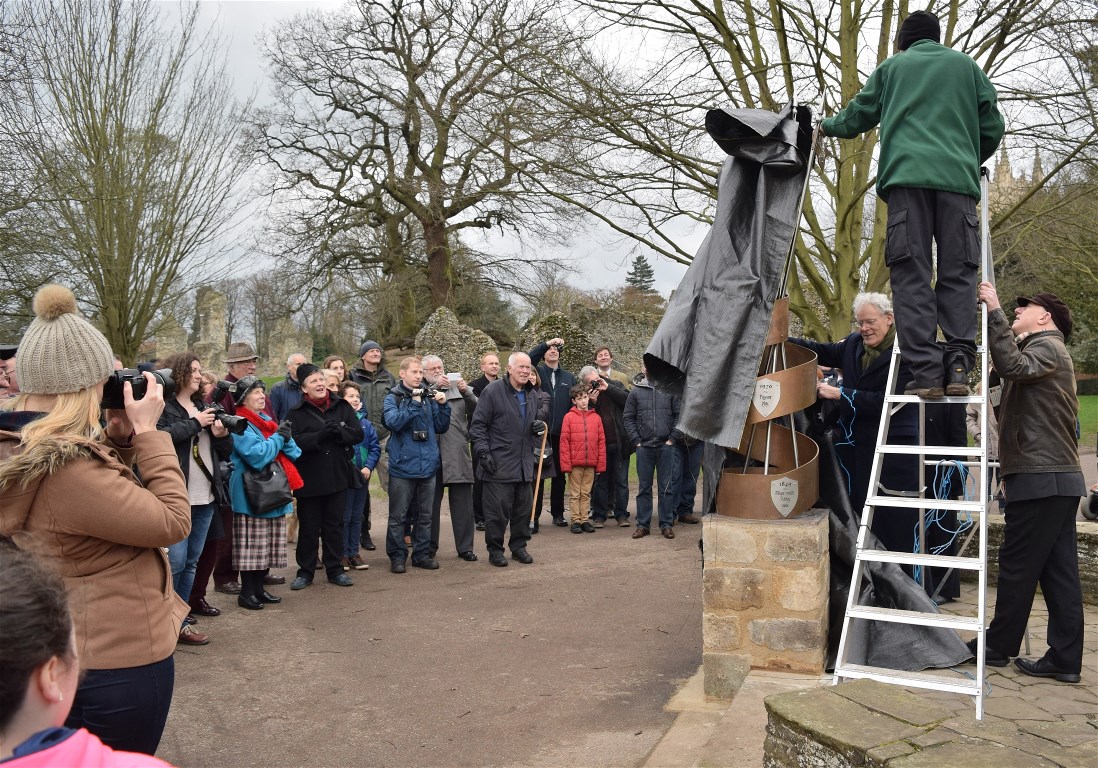
David Carpenter unveils Bury St Edmunds sculpture

The Magna Carta Project's David Carpenter was recently called upon to help unveil a sculpture in Bury St Edmunds.'Our Liberty' commemorates the role of the town in the events surrounding Magna Carta - according to the chronicler Roger of Wendover, a group of discontented barons met at the abbey in the autumn of 1214 and sworn to unite in resistance to King John. You can read a translation of Wendover's account, together with a commentary by the MCP's Nicholas Vincent, on the Magna Carta Project site. For a vindication of Wendover's account, see David Carpenter's book Magna Carta (2015), pp. 290-95. You can read more about the Bury sculpture via the Magna Carta Trust.
David helps to unveil the sculpture in Bury
David with the mayor of Bury, Margaret Charlesworth, and other dignitaries

Wednesday, 4 November 2015

Magna Carta World Tour

Members of the team have been flying the Magna Carta Project flag across the globe this autumn, as part of a Foreign Office programme of events commemorating the Charter's 800th anniversary. You can view more pictures on the Magna Carta Project Facebook page.

David Carpenter took part in a public event at NYU Abu Dhabi on 4 October, introduced by the British Ambassador to Abu Dhabi, Philip Parham. Also speaking was Thomas Cogswell (Professor of HistoryUniversity of California, Riverside) and the event was chaired by Lubna Qassim, Executive Vice President and Group General Counsel and Company Secretary of Emirates NBD. David also gave a talk about Magna Carta and money in Dubai.


David also took part in an event in St Petersburg on 13 October, held at the British Consulate General and introduced by HM Consul General Keith Allan. David spoke here about 'The Nature of Magna Carta 1215' and also gave a lecture on Magna Carta to students at St. Petersburg State University School of Law. 

Whilst he was there, he had an opportunity to visit the Winter Palace (above right), including Tsar Nicholas II's Library (below right). 

You can see more photographs from the conference here, and you can read a report on the event by David's fellow speaker, Sergei Golubok (Ph.D. International and European Law, Attorney-at-Law, St Petersburg Bar Association) as a guest post on Keith Allen's blog, here.


While David was talking in St Petersburg, Nicholas Vincent was speaking in Yerevan, Armenia, at a conference hosted by the Armenian Association of World History with the support of the British Embassy in Yerevan. The event was introduced by HM Ambassador Judith Farnworth (pictured on Nick's left in the photograph here), and also there representing the UK was Professor Theo Van Lindt (Professor of Armenian Studies, The Oriental Institute, University of Oxford - picture to Nick's right). You can read more about the event, view photographs and download a pamphlet of the speakers' abstracts on the website of the Armenian Association of World History, and also here

Whilst he was there, Nick visited the ruined Cathedral of Zvartnots, which dates to the seventh century (left). 


Ten days later, on 23 October, David was in Sofia, Bulgaria. The event was held at Sofia University and was hosted by Emma Hopkins, British Ambassador to Bulgaria. In the photograph below right, David is holding 'Magna Carta 800 Years & Her Elder Daughter The American Constitution', a book which includes text in both English and Bulgarian, written by Valentin Braykov (to the right of David in the photograph), honorary legal adviser to the British Embassy. The booklet had a translation of the Charter into Bulgarian by Alexander Shurbanov, professor of English Studies at Sofia University. The Booklet was published by the America for Bulgaria Foundation. 


Currently (4 November), Nick is in the United States on more Magna Carta business - Colorado Springs, followed by New York, Princeton and Ohio - more to follow. 


Monday, 19 October 2015

The Magna Carta Project at Peking University

In September 2015, members of the Magna Carta Project visited Peking University, as part of a delegation led by the Institute of Historical Research. A conference on Magna Carta was hosted by PKU, involving Chinese and British scholars. 
L-R: David Carpenter, Nicholas Vincent, Harry Dickinson, Sophie Ambler, Rachel Foxley, Lawrence Goldman, Alex Lock, Jane Carpenter, George Garnett

Friday, 14 August 2015

Festival of Freedoms


This September, members of the Magna Carta Project will be taking part in Parliament’s Festival of Freedoms. The Festival is part of Parliament in the Making, a year-long cultural and education programme that commemorates a series of major anniversaries including 750 years since Simon de Montfort’s parliament and 800 years since the sealing of Magna Carta.


Westminster Hall, site of the
1265 parliament 
On 15 September, Sophie Ambler will be talking at Portcullis House on ‘What Happened at Simon de Montfort’s Parliament?’. De Montfort’s parliament of 1265 is celebrated as a pivotal episode in the history of politics. But why was the parliament summoned and what actually took place? Sophie will describe the tumultuous context of the parliament, with England’s king imprisoned and the kingdom ruled by a council of his subjects, and examine new evidence to reconstruct the events, personnel and atmosphere of the meeting, in order to reveal the dramatic course of the parliament and its theatrical climax. 

Statue of
Llewelyn the Great,
Conwy
On 17 September, David Carpenter will be speaking at The National Assembly for Wales on ‘Wales and Magna Carta in 1215’. Magna Carta, one of the most famous documents in world history, was sealed 800 years ago in 1215. Here, David will explore the crucial role played by the Welsh rulers in the creation of the Great Charter. Focussing on the rebellion against King John by Llewelyn, Prince of North Wales (later known as Llewelyn the Great) and his allies, he will examine the chapters in Magna Carta dealing with their grievances - revealing that Magna Carta is a very much a British document, with important chapters about both Wales and Scotland.

These events are free and all are welcome but booking is required. To find out more about the Festival of Freedoms, to see the full events listings and to book your place, please visit the 2015 anniversary events page on Parliament’s website. 

Monday, 10 August 2015

Robert fitz Walter on Trial

Recently a mock trial was held in Westminster Hall, in which the Robert fitz Walter and his army faced accusations of treason for their rebellion against King John. David Carpenter played the part of fitz Walter, defended by Nathalie Lieven QC, against Clive Anderson’s King John.

Before a large gathering in Westminster Hall and judges Dame Sian Elias (Chief Justice of New Zealand), Lord Neuberger (President of the Supreme Court)  and Justice Stephen Breyer (of the US Supreme Court), David successfully made the case for ‘not guilty’.

It is hoped that a video of the trial will be available in due course – watch this space!


David Carpenter as Robert fitz Walter defends the rebellion against King John
Nathalie Lieven QC defends Robert fitz Walter
Clive Anderson playing the part of King John

Monday, 29 June 2015

Magna Carta Exhibition at the Weston Library

Dr Hugh Doherty, who curated the Weston Library's Magna Carta exhibition
Visitors to Oxford’s Weston Library during the past month will have seen engrossments of two different versions of Magna Carta, together with a collection of other documents from the period, on display in an exhibition curated by the Magna Carta Project’s Dr Hugh Doherty.

One engrossment is that of the issue of 1217, marking the end of the civil war that followed King John’s rejection of the Runnymede Charter of 1214. The other dates from 1225, when what became the definitive version of the Charter---the Charter subsequently copied into the Statute Book---was issued by Henry III.

Alongside these Charters is a selection of other contemporary and near-contemporary documents and manuscripts from the Bodleian's rich collection relevant to the history of Magna Carta. These include a late twelfth-century manuscript copy of Henry I's coronation edict of 1100, a contemporary copy of King Stephen’s charter of liberties for the English church, and a very interesting, non-chancery copy of the 1215 Magna Carta, possibly transcribed by a clerk in the service of the papal legate Guala and subsequently taken to Italy. Also on display is one of the three surviving manuscripts of Roger of Wendover’s chronicle, which is an essential (if partisan) narrative for events in 1215--17. 

Hugh Doherty explains the thinking behind the exhibition: 'The exhibition highlights two essential themes in the construction and drafting of Magna Carta. The first---much overlooked in popular narratives on the subject---is the tradition of royal edicts confirming and declaring established (as well as imagined) custom and law. Magna Carta thus stands in a long tradition, and this tradition is illustrated by such examples as Henry I's coronation charter and King Stephen's charter of liberties for the English church. The second theme is the flawed and failed nature of John's kingship and personality. There are thus a number of documents in the exhibition relating to the king himself. Magna Carta was a direct and detailed rejection of his kingship'.

The exhibition has now closed, but you’ll be able to read more about these documents in Nicholas Vincent’s forthcoming book on Magna Carta for Bodleian Publishing


Monday, 15 June 2015

English Historical Review: Magna Carta special issue

In celebration of the 800th anniversary of Magna Carta, English Historical Review has published a special issue showcasing key research on the Charter presented in the journal.

The collection was brought together by the Magna Carta Project’s Nicholas Vincent, who contributes an introductory essay surveying over one hundred years of Magna Carta scholarship.

The special issue includes articles from the early twentieth century by J.H. Round and John C. Fox, as well as two articles by the great Magna Carta scholar Sir James Holt, who died in May 2014 (a third edition of Holt’s Magna Carta will be launched this week at the Magna Carta Conference). An article on Stephen Langton by John Baldwin, who died in February 2015, also features – as does David Carpenter’s 2011 discussion of Langton and the Charter. Ifor Rowlands’ article on the publication of Magna Carta, published posthumously in 2009, is also included.


The articles from the Magna Carta issue, including Nicholas Vincent’s introductory survey, can be downloaded free of charge from the EHR website

Thursday, 21 May 2015

EconTalk podcast: Nicholas Vincent on Magna Carta

The British Library's Unburnt Magna Carta
The Magna Carta Project's Nicholas Vincent recorded a podcast on Magna Carta recently for EconTalk, part of the Library of Economics and Liberty in the USA. Nick spoke to Russ Roberts, of Stanford University, in depth about the political and economic background to Magna Carta, the events at Runnymede in June 1215 and the Charter's content, as well how Magna Carta took on a totemic significance through the course of the thirteenth century.

You can download the interview as a podcast, and read a transcript, on the EconTalk website - it's a great resource for learning about Magna Carta and its world. 

And you can hear Nick - along with a host of other Magna Carta experts - at the Magna Carta Conference, at King's College London and the British Library, 17-19 June 2015.

Mortimer History Society Spring Conference

The Magna Carta Project’s David Carpenter spoke recently at Mortimer History Society Spring Conference, which took place at Hereford on 16 May. The subject of the conference was ‘Law and Order in Early Medieval England’.


Here’s David with the conference’s other speakers and members of the Society: (l-r) ‘The Royal Executioner’, Elizabeth Chadwick, Matthew Stevens, Paul Dryburgh, Daniel Power, Ian Mortimer, Jason O’Keefe and David Carpenter.


Both David and Dan Power will be speaking at The Magna Carta Conference, 17-19 June 2015: you can see the full programme and access booking through the Conference page

Wednesday, 13 May 2015

Surrey in the Age of Magna Carta

Professors Nigel Saul (left) and David Carpenter (right)
at the Surrey History Centre
Magna Carta Project Co-Investigator David Carpenter spoke on Saturday 9th May about 'Magna Carta in the Reign of Henry III', at a Magna Carta study day at the Surrey History Centre in Woking. Here he is with Nigel Saul, of RHUL and the Magna Carta Trust, who spoke about 'Magna Carta in English History'.
You can hear both David and Nigel at the Magna Carta Conference, which will take place at King's College London and the British Library 17-19 June 2015. For more information and to book tickets visit the Magna Carta Project website

Wednesday, 6 May 2015

The Cheshire Magna Carta

The Cheshire Magna Carta
‘Both by royal permission and the virtues of its earls’, wrote the monk of Chester abbey, Lucian, about 1195, Cheshire ‘is accustomed to answer in its assemblies more to the sword of its prince than the crown of the king’.[i] There has been much debate over how far the earl of Chester - described here as a ‘prince’ - enjoyed exceptional, autonomous, authority in Cheshire in the decades prior to its takeover by the crown in 1237 and the development thereafter of a ‘palatinate’ tradition by a county community keen to assert claims to special privileges. The first formal record that we have of Cheshire as a ‘county palatine’ does not come until the 1290s.[ii]

Be that as it may, Lucian’s statement is testimony to a perception of Cheshire, during the earldom of Ranulf III (1181-1232, though a minor until 1187) as separate from the rest of the kingdom. The issue by Earl Ranulf of a ‘Magna Carta’ for the county, almost certainly in 1215, as a local counterpart to the Runnymede Magna Carta granted by King John, is an example of that separatism in practice. It is fitting, therefore, that Cheshire Local History Association has chosen to mark the 800th anniversary by publishing The Magna Carta of Cheshire, a booklet of just over 100 pages which includes a new translation of Earl Ranulf’s charter, accompanied by a detailed commentary on its context and content. Some of the key features of the charter are also highlighted in the Feature of the Month for May.

In terms of number of words, Earl Ranulf’s charter was about one-third the length of King John’s Magna Carta. There were far fewer chapters or clauses, but among them were some which addressed issues familiar from Runnymede: safeguarding the interests of widows and minors, relaxing restrictions within the earl’s forests and limiting obligations to castle-guard. There was also a promise that concessions should extend beyond the immediate beneficiaries, the Cheshire barons, to their own knights and free tenants - seemingly a deliberate echo of Magna Carta cap. 60 and, if so, good evidence that those who framed the Cheshire charter intended that it would stand within the county in place of the king’s. Alongside these were concessions which had no parallel with those made at Runnymede, including two dealing with claims over ‘avowers’ - fugitives settling in the county - and a remarkable chapter in which the earl itemised those baronial petitions he had turned down. Among these, if the phraseology has been interpreted correctly, was a bid to have hare-coursing laid on whenever the barons were summoned to Chester! Even some of the chapters for which there were precedents at Runnymede incorporated distinctive Cheshire concerns. There was protection of the right to plead ‘thwertnic’ (‘I deny it all’) in the earl’s court, which appears to have had the effect of frustrating prosecutions, and a guarantee that military service would not be enforced beyond the Lyme, the sharply-defined area of wooded upland which delineated Cheshire’s eastern and south-eastern frontier with the rest of England.

It is fair to say that the Magna Carta of Cheshire, though twice published in scholarly editions during the twentieth century[iii] and duly mentioned in passing in several books on Magna Carta, has not until now received the attention it deserves. It offers us an insight into the hopes and fears of the landholding class in an under-populated frontier shire, away from the main centres of royal power in early thirteenth-century England.


[i] Liber Luciani de Laude Cestrie, ed. M.V. Taylor (Record Society of Lancashire and Cheshire,  LXIV, 1912), p. 65.
[ii] See  e.g. G. Barraclough, ‘The Earldom and County Palatine of Chester’, Transactions of the Historic Society of Lancashire and Cheshire, CIII (1951), pp. 23-57; J.W. Alexander,  ‘New Evidence on the Palatinate of Chester’, English Historical Review, LXXXV (1970), pp. 715-29 and Ranulf of Chester, a Relic of the Conquest (Athens, Georgia, 1983), esp. pp. 60-68; Victoria County History: Cheshire, II, pp. 1-8; D. Crouch, ‘The Administration of the Norman Earldom’ in A.T. Thacker, ed., The Earldom of Chester and its Charters (Journal of Chester Archaeological Society, LXXI, 1991), pp. 69-95.
[iii] Chartulary or Register of St Werburgh, Chester, ed. J. Tait (Chetham Society, new series, LXXIX, LXXXII, 1920, 1923), I, no. 60; Charters of the Anglo-Norman Earls of Chester, c.1071-1237, ed. G. Barraclough (Record Society of Lancashire and Cheshire, CXXVI, 1988), no. 394.

Sunday, 3 May 2015

Pageants and the People: Bury St Edmunds and Magna Carta

Throughout 2014-15, local communities across the UK are marking the 800th anniversary of Magna Carta with a host of varied festivities – from Odiham's specially commissioned Magna Carta Anthem to Runnymede's parade of picnicking giants. But did you know that Britain has a rich history of commemorating history through such theatrical events? For instance, In 1907, 1959 and 1970 the people of Bury St Edmunds commemorated the Charter by re-enacting events from their town’s past, in three big historical pageants.
The Bury pageant of 1959
Bury’s pageants are being investigated as part of a major AHRC project, The Redress of the Past: Historical Pageants in Britain. The project looks at the part of pageants in community life and how communities expressed their identity through theatrical re-creations of their past. Members of the project team (from King’s College London, the Universities of Strathclyde and Glasgow and the Institute of Education) have been looking at twentieth-century pageants from across the UK. You can see some of the weird and wonderful photographs of these events and read commentary by the team in the Pageant of the Month feature – and you can even upload your own pageant photographs and memorabilia.

The Bury pageant of 1907
The project is helping to commemorate the Bury St Edmunds pageants in a special exhibition in Moyse’s Hall, Bury, which will run from 4th May 2015. On display will be rare film footage of the pageants as well as souvenirs produced for the events – visitors will also be able to have their photo taken with life-size figures of pageant characters. Meanwhile, the Redress of the Past website will host an online version of the exhibition, including behind-the-scenes stories and features. Do take a look! 

Friday, 20 March 2015

The Magna Carta Project in the USA

Members of the Magna Carta Project travelled to the USA recently to share the Project’s research with academics, students and members of the public across the pond.

Rick Griffin, Director of the Center for Constitutional
Studies at UVU, introduces Nicholas Vincent
Nicholas Vincent, Louise Wilkinson and Sophie Ambler spoke at Utah Valley University, whose Center for Constitutional Studies hosted a symposium on Magna Carta on 17 February 2015. The event was opened by Nicholas Vincent, with: “From (Bad) King John to (Good) Magna Carta: How an 800 year-old Charter Changed the World”. As well as explaining the origins of the Charter in the reign of King John and his predecessors, Nicholas showed how Magna Carta had influenced constitutional documents in the United States, including Utah’s own State Constitution.

Salt Lake City, Utah: view of the Temple precinct of the Church of the Latter Day Saints. It was in nearby Orem, at Utah Valley University, that the symposium was held.
Louise Wilkinson explains what Magna Carta did for
women
Sophie Ambler on the Church and Magna Carta
In a later panel, Louise Wilkinson described how the Angevin kings' treatment of widows and heiresses provoked clauses protecting women’s rights in Magna Carta, and showed the impact of the Charter on thirteenth-century society. Sophie Ambler talked about the role of the Church in making and enforcing Magna Carta in the thirteenth century explaining how, in an age in which politics was imbued with religious ideas, churchmen were central to the Charter’s story. Nicholas Vincent then described the Project’s work, including his role in studying the charters of King John and in examining the four original 1215 Magna Cartas, as well as sharing some of the Project’s major new discoveries, such as the Canterbury Magna Carta.


The visit to Utah was followed by David Carpenter's trip to California, coincidentally his first visit to America. At UCLA, on 23 February, David gave a talk on Magna Carta to the Centre for Medieval and Renaissance Studies. This was chaired by Scott Waugh, Professor of Medieval History at UCLA and Provost and Executive Vice-chancellor. 
David introducing the Canterbury Magna Carta, here in
the Pine engraving

David then went on to Stanford University where, on 25 February, he ran a seminar for its Center of Medieval and Renaissance Studies about 'Magna Carta: problems of translation and interpretation'. He followed this with a public lecture about Magna Carta which was attended by over 250 people. Here he shared the bill with Professor Jack Rakove, Pulitzer Prize winner and professor of History at Stanford, who considered the place of Magna Carta in shaping the American constitution. The session was chaired by Eliane Treharne, Professor of English at Stanford.      

David in discussion with Jack Rakove

Friday, 20 February 2015

Discovering the Sandwich Magna Carta, by Professor Nicholas Vincent

Professor Nicholas Vincent
Magna Carta Project Principal Investigator
In this special edition of the Magna Carta Project blog, our Principal Investigator Professor Nicholas Vincent tells the full story behind the discovery of the Sandwich Magna Carta:

Although I have spent a large part of the last three years travelling and searching on behalf of this project, I have thus far refrained from anything so vainglorious as a 'blog'. I make an exception in the present instance only because this really is a story worth telling.

On 8 December 2014, I gave a talk on Magna Carta at Queen's University Belfast, to the Northern Ireland Human Rights Festival. This was in an admirable cause, and attracted a good audience. Afterwards, and following dinner with my friends, the Flanagans and the Hannams, laid on by the organizers, I found myself at midnight in Belfast, with time on my hands. I could have read, or switched on the television. But television is the insomniac's last resort. Instead, I thought I would trawl through the online listings of the Kent Archives in Maidstone. This might not be everybody's first choice of late night hotel entertainment, but you must bear in mind that I have spent a great deal of time over the past three years visiting archives in England and France for the purposes of our Magna Carta Project, and that Maidstone was next on my list. All told in my career, I must have visited more than three hundred archives, and in each case preparation has been crucial.  Just to turn up and hope to work through catalogues is to guarantee disappointment. The catalogues are often incomplete. They are rarely easy to handle. And there tend to be a lot of them. Instead, using my old notes, in some cases dating back to the 1980s, and judicious searches of online catalogues, I have generally found a lot of what we are looking for, well in advance of any visit. For the purposes of our project, we are chasing anything to do with King John, and anything to do with Magna Carta, from near-contemporary thirteenth-century copies of the charter, all the way through to facsimiles given away by petrol stations in the 1970s.


Kent History and Library Centre, Maidstone
Maidstone is an archive that I know relatively well. In the 1970s, I attended a specialist music school in Maidstone. I taught from 1994 to 2003 at Christ Church Canterbury. As a result, I had visited the Maidstone archive, if not frequently, then perhaps a dozen times. In recent years, the Maidstone office has moved from County Hall to a new and larger site. There it accommodates archives formerly held in the East Kent Record Office near Dover. These archives, I had not previously seen, in part because I supposed them to contain nothing medieval that was not already known, in part because they were housed some way outside Dover: like many academics, I have regularly failed my driving test.

So at about 1am Belfast time, I began typing in search terms to the Maidstone online catalogue. I started with 'King John' and then 'Magna Carta'. This produced very little, although in the longer term, as I now know, it has helped to nail down a document of the 1760s, not of immediate concern here, but crucial to our understanding of the circumstances in which the 'Articles of the Barons' (an early draft of Magna Carta) came into the possession of the British Museum, and hence of the British Library. At this stage, I might just have given up. However, three decades of this sort of thing have taught me that the best discoveries lurk deep within the catalogues, and that fishing for them is a matter of patience and perhaps some skill. I therefore went on a chronological search, refining the search criteria to 'charter' within a date range before 1350. This brought up about thirty entries, some of them (as is inevitable) jejune, or already covered by my own handwritten notes from the '80s and '90s. Almost the last of them was a reference to a 'Mutilated fragment of a charter of Edward I ?1300 Forest Charter' belonging to the borough of Sandwich.

Illustration from The Purloined Letter, by Edgar Allan Poe
Now, I have often found that the most interesting original records of Magna Carta, as of much else, have gone unnoticed precisely because they are assumed either to be copies rather than originals or because they travel with other less famous documents. Cataloguers, assuming that Magna Carta is much too important to have been overlooked, have very frequently assumed that originals are copies, not from any physical evidence of the fact, but simply because the idea of possessing an unknown Magna Carta has appeared to the cataloguer to be as absurd as suddenly stumbling upon an unknown play by Shakespeare or a unknown canvas by Vermeer. The most famous documents are often the documents that, in their natural habitat, have been least studied. Edgar Allan Poe sums up this situation perfectly in his story 'The Purloined Letter'. Poe's plot here turns on the fact that, if you wish to hide something that everybody else assumes hidden, the best place to hide it is in plain view. 

The Hereford Magna Carta of 1217
I can claim, long before last December, to have found at least three Magna Cartas. All were in plain view. None of them was 'unknown', in the sense that they had all previously been listed, albeit in obscure places, either as Magna Cartas or as 'copies' of Magna Carta. They were nonetheless 'unknown' in the sense that they were either assumed to be 'copies' or 'duplicates' rather than originals (one of the three 1217 Magna Cartas, and the 1225 Magna Carta in the Bodleian Library in Oxford), or were known locally but without any appreciation that local knowledge had not come to national or international attention (the 1300 Magna Carta preserved in the archives of the borough of Faversham). In one instance (the 1217 Magna Carta now in Hereford Cathedral), it had been catalogued as a royal charter of liberties, but without realizing that these liberties were those otherwise known as 'Magna Carta'. I vividly remember phoning Hereford Cathedral, in 1989, and asking if I could go down there the following day to see their Magna Carta (for there could be little doubt from the catalogue entry that Hereford's 'Charter of liberties 1217' was a 1217 Magna Carta). I received a very dusty answer. 'We have no Magna Carta', I was told, 'You must be thinking of Mappa Mundi!'. Ignoring this, and ordering up the document by call number, I found myself, the following morning, greeted on Hereford railway station by the canon librarian and the delightful cathedral archivist, Meryl Jancey. Archivists and canon librarians do not generally go to the railway to greet visiting postgraduate students. Short of playing me up Hereford High Street with a brass band, they could not have expressed more joy. And inevitably, their first question was 'How much is it worth?'.

Then as now, I ducked the question. A valuation, unless for insurance purposes, implies a temptation to sell, and institutions such as cathedrals or towns are rarely well advised to sell their medieval treasures. One might as well sell the stones of Westminster Abbey or the White Horse of Uffington. Such things have been long enough in the possession of a particular place to be immunized against all (or at least most) commercial considerations. Those that sell them (and I think here of a notorious case of a manuscript belonging to an ancient and famous Hampshire school) have sometimes sold in haste only to repent at leisure. In the meantime, I suspect that it was as a result of telling the story of Hereford Cathedral's charter that the next chapter of my involvement with Magna Carta came about. In 1999, my time as a visiting fellow of All Souls College Oxford coincided with that of an eminent historian of the medieval book, closely associated with the auction house Sotheby's (Christopher, I trust that you prefer anonymity here). This eminence, having heard me talk on the Hereford and other charters, recommended me, a few years later, to act as expert advisor when Sotheby's came to auction an original Magna Carta, of the 1297 issue, in sale at New York. As a result, in 2007, I compiled what was intended as a definitive listing of all Magna Carta manuscripts, originals and some copies, then known to survive. This in itself was an interesting undertaking, since there had previously been only two such lists, the first published by William Blackstone in 1759, the second sixty years later. 

Portrait of Sir William Blackstone (1723-80)
In 1810, in the midst of wars between England and France, and no doubt spurred on by the desire to out-do the Code Napoleon, the Record Commissioners appointed by King George III published the first of a dozen folio volumes devoted to Statutes of the Realm. Here, they attempted to assemble definitive texts of laws and statutes that until then had lain in considerable confusion and neglect. As part of this exercise, they travelled around England looking for old laws. Their findings were summarized at the beginning of their first volume, which included not only Latin texts but several beautifully engraved facsimiles (by James Basire) and a preliminary listing of manuscript sources. 

Blackstone, who for the first time succeeded in properly distinguishing between the Magna Carta of King John and its later issues, knew of seven originals issued between 1215 and 1300. The Record Commissioners managed to find no less than twelve exemplars, at least one for each of the successive issues of 1215, 1216, 1217, 1225, 1297 and 1300. In the process, they inevitably overlooked things that in more recent times have resurfaced. Thus the Commissioners of 1810 knew that there ought to be a 1215 Magna Carta at Salisbury. This they were unable to locate. It has since re-emerged and is now one of the four iconic Magna Cartas of King John. They overlooked all but one of the four 1217 Magna Cartas, two of the surviving 1225 charters, three of the issue of 1300 and another three of the issue of 1297: all told, a further twelve originals. By the time that my census of Magna Carta manuscripts was published in 2007, all but one of these had either come to light or was newly unearthed as a result of the Sotheby's sale. Before 2007, the most exciting discoveries had been those made in the 1930s at Bruton School in Somerset (a 1297 charter sold in 1953 to the Australian government, and now in Canberra), and of another 1297 charter, at Deene Park in Northamptonshire, recovered in 1975 from the local county record office by its owners, the Brudenell family, and in 1983 sold to the American billionaire, Ross Perot. Mr Perot deposited it for display in the National Archives in Washington. It was this Deene Park/Washington charter that in December 2007 was sold at Sotheby's in New York for $21.3 million.

The Forest Charter of 1225, British Library
Add. Ch. 24712
One other detail before we pass on. Magna Carta as issued in 1215 promised reform not only of the realm as a whole but of the King's administration of those parts of England placed under 'forest law' (i.e. set aside for the King's hunting, with severe consequences for land use and the preservation of game). In 1217, to answer this demand for reform, King Henry III not only issued a new version of Magna Carta but, as a companion piece, an entirely distinct and smaller charter known as the 'Forest Charter'. From 1217 onwards, the Forest Charter travelled in the company of Magna Carta, rather as a pilot fish accompanies a shark. It was in order to distinguish between these two documents, bigger and smaller, that as early as 1217 Magna Carta was first named 'Magna' ('the great'). Thereafter, on each successive reissue of Magna Carta, the Forest Charter was also reissued, in 1225, 1265, 1297 and 1300. The Record Commissioners, in their search for original documents, were much less thorough in their treatment of the Forest Charter than they were in their search for its more famous sibling. Blackstone had found only two original Forest Charters, both of them very late. The Record Commissioners knew of only three. By contrast, we now know that at least twelve survive. Some of these turned up fortuitously at the time of my own search for new manuscripts in 2007. Others had resurfaced even more recently.

So it was, that around 4.30am in the morning of 9 December 2014, I decided that a catalogue entry describing a Forest Charter of 1300, might well merit further investigation. Even in the seven years between 2007 (when I compiled my lists for Sotheby's) and 2014, when I stumbled on the reference to the borough of Sandwich's  Forest Charter, I had found at least three further original Forest Charters previously misidentified or ignored. The earliest of these, of 1225, came to light amongst the muniments of Ely Cathedral, the most recent, of 1300, in the British Library. An original of 1300 at Oriel College seen by Blackstone, reported missing in 2007, had re-emerged safe and sound.

Thanks to modern technology, from Belfast to Maidstone is a mere click of the mouse. At 4.39 Greenwich meantime on the morning of 9 December last year, I sent an email (I have it in front of me) to Dr Mark Bateson. I have known Mark for nearly twenty years, first as an archivist at Canterbury Cathedral (where he was one of those who devised the magnificent catalogue of Canterbury's medieval charters), and more recently following his transfer to Maidstone. I told him that I had found the reference to a Forest Charter , and as I noted in my email: 'If this really is the 1300 Sandwich copy of the forest charter, issued under the seal of Edward I, then it is a major find. There are only a handful of such exemplifications still surviving as originals. It would also fundamentally alter our understanding of the way in which the charters of liberties were distributed for the later reissues of Magna Carta. Is there any chance of your taking a sneak preview?'

Dr Mark Bateson with the Sandwich Magna Carta
Mark duly went to the shelves and looked at the document. Two days later, he wrote back to tell me that the Sandwich Forest Charter did seem to be as described, although in a rather battered state. He then added a postscript that set more dramatic events in train. 'And by the way', he wrote, 'There is the Sandwich copy of Edward’s 1300 confirmation of Magna Carta next to the Forest Charter in the same volume. We didn’t know about that, so it’s a doubly excellent discovery from our point of view'.

Within a matter of minutes, he may have been surprised to receive my panicked reply sent from Paris, drawing his attention to the fact that this was not just a nice discovery but something really very special. For all of the fuss about the Magna Carta sold in 2007, or the Magna Cartas which that sale had helped bring to light, no entirely unknown original of the charter had been found since the 1970s, when Mrs Brudenell came across the Deene Park Magna Carta, listed in a catalogue in the county record office at Northampton.

The Sandwich Magna Carta of 1300
It took me a week of other obligations before I could make my trip to Maidstone. As soon as the document was shown to me, on the morning of 19 December, I knew that it was a Magna Carta. If you spend as much time as I have spent over thirty years working on medieval charters, there is really no doubt when a thing like this turns up. Forgery took place on an industrial scale in the Middle Ages as now. But forgers in the thirteenth century were for the most part interested in forging much earlier documents, not in manufacturing things like false Magna Cartas. As for the idea that such a thing could have been made in more recent times, once again there are all sorts of tell tale signs that help us to distinguish the false from the authentic. Some of this is skill, some of it hard work, a lot of it what an antiques dealer or art historian would consider standard connoisseurship. As any connoisseur will tell you, there is also nothing quite to compare with the moment when you first see something, previously hidden, that you immediately know to be the real article. It brings a smile to the lips and a sensation of heightened reality, not dissimilar to that which you feel when you first see your children walk.

From this point onwards, it was plain that there would be media interest, and that we should immediately alert the owners of the document (the borough of Sandwich) and those other parties who might have a vested interest. To inform the town council of Sandwich, Mark turned to a delightful person named Laura Fidler, Sandwich's town clerk. Laura, realizing that she had a drama on her hands, managed to keep the news secret over Christmas. But whispers inevitably circulate. It was only a matter of time before the media got hold of the story. This they did, last Saturday, leading to a front page story in the Sunday Times, and a great deal of national and international publicity thereafter. In all of this, Laura Fidler was a magnificent defender of local interests. It was only when she realized that the story was about to break that she authorized a press release, and allowed Mark and myself to talk to the media. It was her handling of all this that made the story such a positive one for Sandwich.

The Magna Carta Project, www.magnacartaresearch,org
As for the story itself, it provides a wonderful boost for Sandwich, for Maidstone, for Kent and for the AHRC's Magna Carta Project. Various valuations have been placed upon the Magna Carta, either on its own, or as part of a pair. I myself have been careful to avoid naming a figure. Both of the Sandwich charters are in poor condition. Yet, even so, only three such pairs survive from the 1300 issue: that at Sandwich, another in Oriel College Oxford, and a third in the archives of Durham Cathedral. For the rest, there is a pair of 1225 Magna Carta and Forest charter at Durham, and a pair of 1297, now split between a Forest Charter in the British Library and a Magna Carta in Canberra Australia. All of this places Sandwich in a very select group. I count only fourteen institutions, of which Sandwich is one, that possess original Magna Cartas, and only three (Sandwich, Durham and Oriel College) that own matching pairs of Magna Carta and Forest Charter.[1]

18th-century engraving of Faversham
In terms of its intrinsic significance, what is new about the Sandwich charter? To look at, it is far from lovely. It has suffered so badly from damp that a large part of the middle of the text has rotted away. Parchment, which is to say sheep skin, supplies ideal gnawing matter for rats and mice. Sandwich itself was burned by the French in 1457, and thereafter lost its status as a major port, as both the Stour navigation and the channel dividing Thanet from the mainland silted up. In due course, when we have properly collated what remains, we may find that the Sandwich charter has subtle variations on the base text of the 1300 Magna Carta, significant in establishing the charter's definitive form. Much more importantly, the very fact that Sandwich, like Faversham, possessed a Magna Carta, suggests that the 1300 charter was more widely distributed than we have previously supposed. It apparently went to all of the Cinque Ports. It went to every county. It may also have gone to cathedrals, major monasteries and towns. In other words, whereas the original Magna Carta, issued by King John in 1215, went to only a dozen or so destinations, of which no less than four managed to preserve their charter, the later reissues, including that of 1300, were much more widely distributed yet have survived in much smaller proportion counting survivors against those originally sent.

What else does the story of the Sandwich Magna Carta teach us? Above, I would suggest, that the medieval archives of England still have treasures waiting to be found. Many of these will be discovered in plain view, sometimes assumed from their very notoriety too good to be true. I am fairly confident that there are other original Magna Cartas still out there. We must be cautious. I myself have been called upon, in the past, to authenticate documents believed by their owners to be Magna Cartas, which on inspection have turned out to be nothing of the sort. I particularly recall a visit in New York, where I was shown what was supposed to be a Magna Carta. It was in fact a facsimile of the 1970s, distributed in a rather splendid series of portfolios, collected by my generation of school children, known as 'Jackdaw Packs'. The makers of the Magna Carta 'Jackdaw Pack' had somehow got confused between Magna Carta, and another related document, known as the 'Articles of the Barons'. As a result, it was the Articles, rather than the charter, that was shown to me in New York. Even so, it had to be pointed out to this particular disappointed owner that neither Magna Carta nor the Articles of the Barons is generally found, in the thirteenth-century original, supplied with a typed English translation on the document's back!

Detail of portrait of James Brydges,
1st Duke of Chandos, by Michael Dahl
Since we are still hot on the trail, I do not intend here to give away every lead that I have to pursue.  Suffice it to say, that at the sale of the (bankrupt) Duke of Chandos's manuscripts in 1747 a Magna Carta was sold ('very ancient') for three shillings and sixpence. It has not since been traced. In 1810, the Record Commissioners reported the survival of a 1300 Magna Carta in the borough archives of Appleby. No such original can now be found. A letter of 1873 in the archives of the British Library claims knowledge of the whereabouts of an entirely unknown Magna Carta, 'a heir loom of my family'. The fact that this correspondent was unable to spell (claiming ownership of 'the Magna Carter of England') and wrote from what seems to have been a London crossing sweeper's cottage may not incline us to suspend disbelief. Even so, in the world of medieval manuscripts, even the most implausible of stories sometimes turn out to be true. 

Nicholas Vincent

An abridged version of this blog appeared in the Times Literary Supplement, 20 February 2015.  For a full and up to date census of Magna Carta manuscripts, as well as a new history of the charter and its posterity, see Nicholas Vincent's forthcoming Magna Carta: Making and Legacy (Bodleian Library Publications, Oxford 2015). For an illustrated history, see Magna Carta: The Foundations of Freedom, ed. N. Vincent (Third Millennium Books, London 2015). For the charter of 1215, there is a splendid new account by David Carpenter, Magna Carta (Penguin Books 2015). The findings of our AHRC project feed into the British Library's forthcoming exhibition, 'Magna Carta: Law, Liberty, Legacy', running from 13 March to 1 September 2015.


[1] Magna Cartas: London, British Library (1215 X 2, 1225); London, The National Archives (1225, 1297); London, Metropolitan Archives/Corporation of London (1297, 1300); Lincoln Cathedral (1215), Salisbury Cathedral (1215); Durham Cathedral (1216, 1225, 1300); Hereford Cathedral (1217); Westminster Abbey, Oriel College Oxford and the boroughs of Faversham and Sandwich (each with a 1300 charter); Oxford, Bodleian Library (1217 X 3, 1225, 1300), and two archives outside the UK, the National Archives in Washington (1297, deposited by the owner, David Rubenstein) and the Australian Senate in Canberra (1297).  Forest Charters: London, British Library (1225, 1297, 1300 X 2); Cambridge University Library (1225, from Ely); Durham Cathedral (1217, 1225, 1300); Lincoln Cathedral (1217, 1225); Oxford, Oriel College (1300), and now Sandwich (1300).