Visit The Magna Carta Project website for more on Magna Carta and King John.
Showing posts with label David Carpenter. Show all posts

Wednesday, 10 February 2016

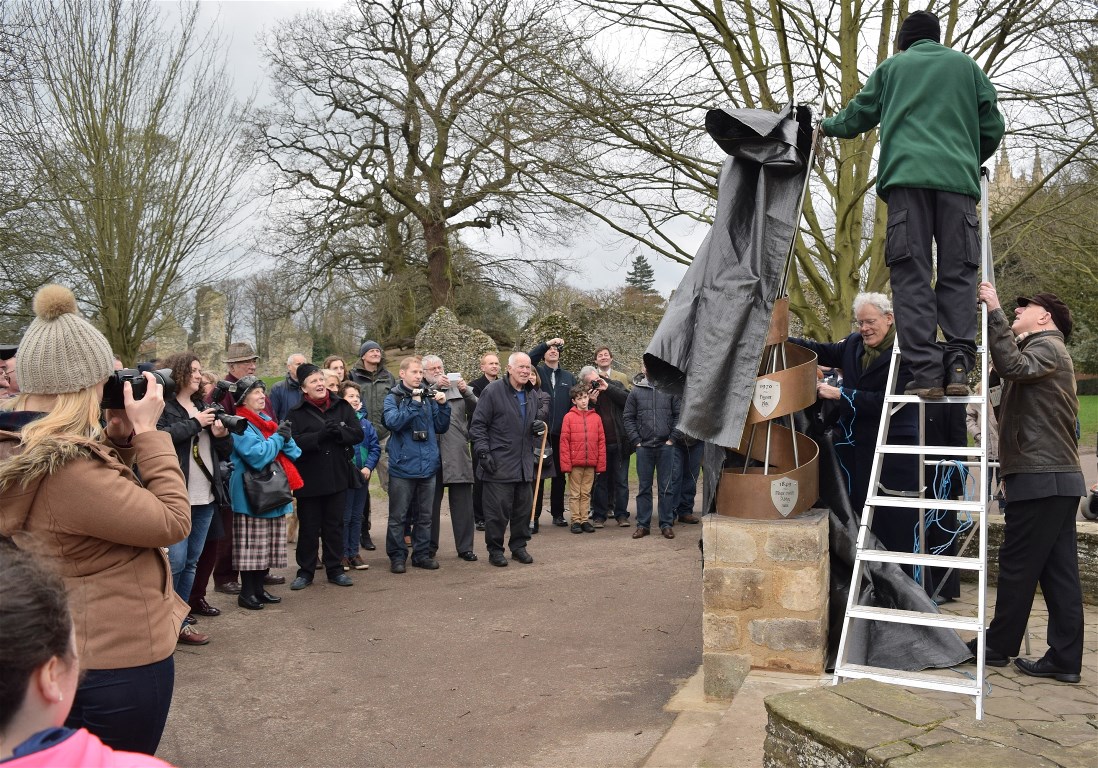
David Carpenter unveils Bury St Edmunds sculpture

The Magna Carta Project's David Carpenter was recently called upon to help unveil a sculpture in Bury St Edmunds.'Our Liberty' commemorates the role of the town in the events surrounding Magna Carta - according to the chronicler Roger of Wendover, a group of discontented barons met at the abbey in the autumn of 1214 and sworn to unite in resistance to King John. You can read a translation of Wendover's account, together with a commentary by the MCP's Nicholas Vincent, on the Magna Carta Project site. For a vindication of Wendover's account, see David Carpenter's book Magna Carta (2015), pp. 290-95. You can read more about the Bury sculpture via the Magna Carta Trust.
David helps to unveil the sculpture in Bury
David with the mayor of Bury, Margaret Charlesworth, and other dignitaries

Wednesday, 4 November 2015

Magna Carta World Tour

Members of the team have been flying the Magna Carta Project flag across the globe this autumn, as part of a Foreign Office programme of events commemorating the Charter's 800th anniversary. You can view more pictures on the Magna Carta Project Facebook page.

David Carpenter took part in a public event at NYU Abu Dhabi on 4 October, introduced by the British Ambassador to Abu Dhabi, Philip Parham. Also speaking was Thomas Cogswell (Professor of History, University of California, Riverside) and the event was chaired by Lubna Qassim, Executive Vice President and Group General Counsel and Company Secretary of Emirates NBD. David also gave a talk about Magna Carta and money in Dubai.


David also took part in an event in St Petersburg on 13 October, held at the British Consulate General and introduced by HM Consul General Keith Allan. David spoke here about 'The Nature of Magna Carta 1215' and also gave a lecture on Magna Carta to students at St. Petersburg State University School of Law. 

Whilst he was there, he had an opportunity to visit the Winter Palace (above right), including Tsar Nicholas II's Library (below right). 

You can see more photographs from the conference here, and you can read a report on the event by David's fellow speaker, Sergei Golubok (Ph.D. International and European Law, Attorney-at-Law, St Petersburg Bar Association) as a guest post on Keith Allen's blog, here.


While David was talking in St Petersburg, Nicholas Vincent was speaking in Yerevan, Armenia, at a conference hosted by the Armenian Association of World History with the support of the British Embassy in Yerevan. The event was introduced by HM Ambassador Judith Farnworth (pictured on Nick's left in the photograph here), and also there representing the UK was Professor Theo Van Lindt (Professor of Armenian Studies, The Oriental Institute, University of Oxford - picture to Nick's right). You can read more about the event, view photographs and download a pamphlet of the speakers' abstracts on the website of the Armenian Association of World History, and also here. 

Whilst he was there, Nick visited the ruined Cathedral of Zvartnots, which dates to the seventh century (left). 


Ten days later, on 23 October, David was in Sofia, Bulgaria. The event was held at Sofia University and was hosted by Emma Hopkins, British Ambassador to Bulgaria. In the photograph below right, David is holding 'Magna Carta 800 Years & Her Elder Daughter The American Constitution', a book which includes text in both English and Bulgarian, written by Valentin Braykov (to the right of David in the photograph), honorary legal adviser to the British Embassy. The booklet had a translation of the Charter into Bulgarian by Alexander Shurbanov, professor of English Studies at Sofia University. The Booklet was published by the America for Bulgaria Foundation. 


Currently (4 November), Nick is in the United States on more Magna Carta business - Colorado Springs, followed by New York, Princeton and Ohio - more to follow. 


Friday, 14 August 2015

Festival of Freedoms


This September, members of the Magna Carta Project will be taking part in Parliament’s Festival of Freedoms. The Festival is part of Parliament in the Making, a year-long cultural and education programme that commemorates a series of major anniversaries including 750 years since Simon de Montfort’s parliament and 800 years since the sealing of Magna Carta.


Westminster Hall, site of the
1265 parliament 
On 15 September, Sophie Ambler will be talking at Portcullis House on ‘What Happened at Simon de Montfort’s Parliament?’. De Montfort’s parliament of 1265 is celebrated as a pivotal episode in the history of politics. But why was the parliament summoned and what actually took place? Sophie will describe the tumultuous context of the parliament, with England’s king imprisoned and the kingdom ruled by a council of his subjects, and examine new evidence to reconstruct the events, personnel and atmosphere of the meeting, in order to reveal the dramatic course of the parliament and its theatrical climax. 

Statue of
Llewelyn the Great,
Conwy
On 17 September, David Carpenter will be speaking at The National Assembly for Wales on ‘Wales and Magna Carta in 1215’. Magna Carta, one of the most famous documents in world history, was sealed 800 years ago in 1215. Here, David will explore the crucial role played by the Welsh rulers in the creation of the Great Charter. Focussing on the rebellion against King John by Llewelyn, Prince of North Wales (later known as Llewelyn the Great) and his allies, he will examine the chapters in Magna Carta dealing with their grievances - revealing that Magna Carta is a very much a British document, with important chapters about both Wales and Scotland.

These events are free and all are welcome but booking is required. To find out more about the Festival of Freedoms, to see the full events listings and to book your place, please visit the 2015 anniversary events page on Parliament’s website. 

Monday, 10 August 2015

Robert fitz Walter on Trial

Recently a mock trial was held in Westminster Hall, in which the Robert fitz Walter and his army faced accusations of treason for their rebellion against King John. David Carpenter played the part of fitz Walter, defended by Nathalie Lieven QC, against Clive Anderson’s King John.

Before a large gathering in Westminster Hall and judges Dame Sian Elias (Chief Justice of New Zealand), Lord Neuberger (President of the Supreme Court)  and Justice Stephen Breyer (of the US Supreme Court), David successfully made the case for ‘not guilty’.

It is hoped that a video of the trial will be available in due course – watch this space!


David Carpenter as Robert fitz Walter defends the rebellion against King John
Nathalie Lieven QC defends Robert fitz Walter
Clive Anderson playing the part of King John

Monday, 15 June 2015

English Historical Review: Magna Carta special issue

In celebration of the 800th anniversary of Magna Carta, English Historical Review has published a special issue showcasing key research on the Charter presented in the journal.

The collection was brought together by the Magna Carta Project’s Nicholas Vincent, who contributes an introductory essay surveying over one hundred years of Magna Carta scholarship.

The special issue includes articles from the early twentieth century by J.H. Round and John C. Fox, as well as two articles by the great Magna Carta scholar Sir James Holt, who died in May 2014 (a third edition of Holt’s Magna Carta will be launched this week at the Magna Carta Conference). An article on Stephen Langton by John Baldwin, who died in February 2015, also features – as does David Carpenter’s 2011 discussion of Langton and the Charter. Ifor Rowlands’ article on the publication of Magna Carta, published posthumously in 2009, is also included.


The articles from the Magna Carta issue, including Nicholas Vincent’s introductory survey, can be downloaded free of charge from the EHR website. 

Thursday, 21 May 2015

Mortimer History Society Spring Conference

The Magna Carta Project’s David Carpenter spoke recently at Mortimer History Society Spring Conference, which took place at Hereford on 16 May. The subject of the conference was ‘Law and Order in Early Medieval England’.


Here’s David with the conference’s other speakers and members of the Society: (l-r) ‘The Royal Executioner’, Elizabeth Chadwick, Matthew Stevens, Paul Dryburgh, Daniel Power, Ian Mortimer, Jason O’Keefe and David Carpenter.


Both David and Dan Power will be speaking at The Magna Carta Conference, 17-19 June 2015: you can see the full programme and access booking through the Conference page. 

Wednesday, 13 May 2015

Surrey in the Age of Magna Carta

Professors Nigel Saul (left) and David Carpenter (right)
at the Surrey History Centre
Magna Carta Project Co-Investigator David Carpenter spoke on Saturday 9th May about 'Magna Carta in the Reign of Henry III', at a Magna Carta study day at the Surrey History Centre in Woking. Here he is with Nigel Saul, of RHUL and the Magna Carta Trust, who spoke about 'Magna Carta in English History'.
You can hear both David and Nigel at the Magna Carta Conference, which will take place at King's College London and the British Library 17-19 June 2015. For more information and to book tickets visit the Magna Carta Project website. 

Monday, 13 April 2015

Langton by Wragby

David Crook (left) and David Carpenter (right) at
Langton by Wragby
David Carpenter was in Lincoln last week for the Lincoln Record Society’s conference on Magna Carta. On the evening of 7 April, delegates attended a special service in the church at Langton by Wragby, the village where Stephen Langton – the archbishop of Canterbury who helped to negotiate the Charter in 1215 – grew up. David gave an address at the service and David Crook presented to the church a facsimile of the charter held at the British Library that proves Langton’s association with the site. In the photo here, Davids Carpenter and Crook are standing beside the moat of the manor house where Langton grew up.

Friday, 20 March 2015

The Magna Carta Project in the USA

Members of the Magna Carta Project travelled to the USA recently to share the Project’s research with academics, students and members of the public across the pond.

Rick Griffin, Director of the Center for Constitutional
Studies at UVU, introduces Nicholas Vincent
Nicholas Vincent, Louise Wilkinson and Sophie Ambler spoke at Utah Valley University, whose Center for Constitutional Studies hosted a symposium on Magna Carta on 17 February 2015. The event was opened by Nicholas Vincent, with: “From (Bad) King John to (Good) Magna Carta: How an 800 year-old Charter Changed the World”. As well as explaining the origins of the Charter in the reign of King John and his predecessors, Nicholas showed how Magna Carta had influenced constitutional documents in the United States, including Utah’s own State Constitution.

Salt Lake City, Utah: view of the Temple precinct of the Church of the Latter Day Saints. It was in nearby Orem, at Utah Valley University, that the symposium was held.
Louise Wilkinson explains what Magna Carta did for
women
Sophie Ambler on the Church and Magna Carta
In a later panel, Louise Wilkinson described how the Angevin kings' treatment of widows and heiresses provoked clauses protecting women’s rights in Magna Carta, and showed the impact of the Charter on thirteenth-century society. Sophie Ambler talked about the role of the Church in making and enforcing Magna Carta in the thirteenth century explaining how, in an age in which politics was imbued with religious ideas, churchmen were central to the Charter’s story. Nicholas Vincent then described the Project’s work, including his role in studying the charters of King John and in examining the four original 1215 Magna Cartas, as well as sharing some of the Project’s major new discoveries, such as the Canterbury Magna Carta.


The visit to Utah was followed by David Carpenter's trip to California, coincidentally his first visit to America. At UCLA, on 23 February, David gave a talk on Magna Carta to the Centre for Medieval and Renaissance Studies. This was chaired by Scott Waugh, Professor of Medieval History at UCLA and Provost and Executive Vice-chancellor. 
David introducing the Canterbury Magna Carta, here in
the Pine engraving

David then went on to Stanford University where, on 25 February, he ran a seminar for its Center of Medieval and Renaissance Studies about 'Magna Carta: problems of translation and interpretation'. He followed this with a public lecture about Magna Carta which was attended by over 250 people. Here he shared the bill with Professor Jack Rakove, Pulitzer Prize winner and professor of History at Stanford, who considered the place of Magna Carta in shaping the American constitution. The session was chaired by Eliane Treharne, Professor of English at Stanford.      

David in discussion with Jack Rakove

Friday, 13 March 2015

'Magna Carta: Law, Liberty, Legacy' opens at the British Library

Julian Harrison and HRH the Prince of Wales in front 
of the statue of Geoffrey de Mandeville 
Yesterday evening saw the triumphant opening of Magna Carta, Law, Liberty, Legacy at the British Library, by HRH the Prince of Wales. The exhibition is the biggest anywhere devoted to the history of a single document. It brings together an astonishing array of exhibits, in a way that is unlikely to be seen again – from King John’s thumb bone, to Thomas Jefferson’s draft of the American Declaration of Independence, to letters revealing Winston Churchill’s plan to gift Lincoln’s Magna Carta to the USA, as well (of course) as the British Library’s two 1215 Magna Cartas and examples of other thirteenth-century issues. (You can view the collection items here). 


Claire Breay and Julian Harrison show the Savernake hunting horn to HRH the Prince of Wales
Curated by Claire Breay and Julian Harrion, the exhibition was planned with advice from Nicholas Vincent and David Carpenter of the Magna Carta Project, with the support of the AHRC. Already it has received laudatory reviews in the Guardian and the Telegraph. 
Claire Breay introduces a replica of King John's effigy

Tuesday, 10 February 2015

Magna Cartas re-united at the British Library

Nick Vincent, Tessa Webber & David
Carpenter, with Chris Woods
On 4 February 2015, members of the Magna Carta Project joined British Library curators and conservators as well as other experts to examine the four surviving Magna Cartas of King John. This once-in-a-lifetime event came as part of a historic week, in which the Magna Cartas of 1215 held by the British Library and the Cathedrals of Lincoln and Salisbury were brought together, for the first time, in the British Library’s conservation centre. You can read more about the event on the British Library’s Medieval Manuscripts blog.

Tessa Webber & Nick Vincent, in Tessa's
office at Trinity College, Cambridge


In preparation, MCP Principal Investigator Nicholas Vincent had met with palaeography expert Dr Teresa Webber of Trinity College Cambridge to examine images of King John’s other surviving charters. The hope is to discover more about the working of John’s chancery and – if possible – to identify the scribes who wrote the Magna Cartas. (The Magna Carta Project is gathering all of the 250-odd original charters of King John  – some of these are already online, and can be viewed here.)

It soon became clear that the Magna Cartas still have many secrets to reveal – watch this space for further discoveries!

L-R: Julian Harrison (BL), David Carpenter (MCP), Tessa Webber (Cambridge), Emily Naish (Salisbury), Edward Probert (Chancellor of Salisbury), Chris Woods (conservator, Lincoln & Salisbury), Claire Breay (BL), Kristian Jensen (BL), Cordelia Rogerson (BL), Philippa Hoskin (Univ of Lincoln), Gavin Moorhead (BL), Louise Wilkinson (MCP)

Wednesday, 21 January 2015

Democracy Day - 750 years since Simon de Montfort's 1265 parliament

Westminster Abbey Chapter House
Magna Carta Project members appeared on BBC radio and television this week as part of BBC's Democracy Day (20 January) - a series of commemorations inspired by the anniversary of Simon de Montfort's famed parliament of 1265. Commemorations began on 19 January, when Louise Wilkinson appeared on Woman's Hour to talk about Eleanor de Montfort, wife of Simon de Montfort and sister of Henry III. Louise explained Eleanor's perspective on events and her role in the politics of the period. You can listen to this episode of Woman's Hour here, via the BBC website. 

On the same day, the BBC website published an article to which David Carpenter contributed: 'Simon de Montfort: The turning point for democracy that gets overlooked', explaining the significance of the 1265 parliament. You can read David's comments here. He contributed to an article giving a Welsh perspective on events, was interviewed for BBC Wales television and appeared on Good Morning Wales. He also gave live interviews for the BBC international service, as well as for BBC Arabic and Persian. David was also featured on Australian SBS Wolrd News. Later he also spoke on Hereford and Worcester local radio and on the Mark Forrest Show, which goes out across BBC local radio. You can view a video that David made for UK Parliament at Westminster Abbey Chapter House here. 

Sophie Ambler gave live interviews in Westminster Hall on BBC Breakfast, and also appeared in a special feature for BBC Parliament and Daily Politics, a radio version of which was also aired on the Today Programme. She also contributed a guest blog for the History of Parliament, which was featured on the Guardian live politics blog.

You can read Sophie's feature on Simon de Montfort's 1265 parliament, in which Magna Carta was confirmed, on the Magna Carta Project website, as well as David's recent article showcasing a new discovery about the changes made to Magna Carta by Montfort during the parliament. 


Sunday, 11 January 2015

Launch party for David Carpenter's Magna Carta

9th January saw the launch party for David Carpenter’s Magna Carta. The party took place in the Weston Room of King’s Maughan Library on Chancery Lane.


You can view David's Magna Carta on Amazon, and read his essay 'Magna Carta 800 years on' on The Guardian website.
Alice Taylor (KCL) introduces David
David with staff, past and present, from the National Archives. L-R: Nick Barratt, Paul Dryburgh, David Carpenter, Jess Nelson, David Crook, Sean Cunningham

Monday, 5 January 2015

Magna Carta series on BBC Radio 4

This week members of the Magna Carta Project will appear in a four-part series on Magna Carta broadcast on BBC Radio 4. The series, beginning on Monday 5th January at 09.00, opens with an episode on ‘The Road to Runnymede’. It will feature MCP Principal Investigator Nicholas Vincent and Co-investigators David Carpenter and Louise Wilkinson, as well as British Library lead curator and MCP member Claire Breay. The team will discuss with host Melvyn Bragg the background to the Charter. Programmes 2, 3 and 4 will be broadcast on the following three days. 

You can find out more about the series, and access podcasts after the programmes' broadcast, on the BBC website.

Friday, 2 January 2015

David Carpenter's 'Magna Carta' is published with Penguin Classics

1 January 2015 saw the publication of David Carpenter’s new book, Magna Carta, with Penguin Classics. The book provides a new translation of the Charter, presented with original chapter divisions that throw new light on how Magna Carta was understood by contemporaries. 

Reading the text closely, David shows for the first time how the Charter reflected divisions in early-thirteenth society. He also explains the ideas behind the agreement as well as giving a new narrative for the events leading up to Runnymede.

In preparing his book, David has been tracking down copies of Magna Carta 1215, as well as later issues, in medieval records – research that has revealed the existence of numerous drafts of the Charter that were carried off from Runnymede. David’s catalogue of Magna Carta copies can be viewed on the Magna Carta Project Website.

The release of David’s book was featured in a BBC News article by Nick Higham: Just how important is Magna Carta 800 years on?

David has also written an article for the Guardian, which highlights some of his findings.

Together with fellow Magna Carta Project members Nicholas Vincent and Claire Breay, David will be taking part in a four part series on Magna Carta to be aired BBC Radio 4 in January 2015.

Click here to view David’s Magna Carta on Amazon. 

Tuesday, 30 December 2014

Magna Carta on BBC Radio 4's Beyond Belief

A depiction of Stephen Langton forcing Magna Carta on King John
Magna Carta Project Co-investigator David Carpenter appeared this week on BBC Radio 4’s Beyond Belief, to discuss the Church’s involvement with Magna Carta. David discussed the Interdict and Stephen Langton’s role in drawing up and upholding the Charter with the Dean of Salisbury, the Very Reverend June Osborne, and Simon Barrow, a Co-director of Ekklesias (a Christian think tank). You can listen to a podcast of the programme on the Radio 4 website.

Sunday, 12 October 2014

Henry III and Edward the Confessor

Edward the Confessor, 
 BL Royal 20 A II f.5
13 October is the feast of the translation of Edward the Confessor, spiritual patron of Henry III. In 1245, Henry began to rebuild Westminster Abbey in the Confessor’s honour and, from around the same time, made every effort to be present at Westminster on both of his patron’s feastdays (the other being the anniversary of the Confessor’s death, 5 January).  

How and why did Henry become attached to the Confessor? In an article for English Historical Review of 2007 David Carpenter argued that, in the mid-1230s, Henry began to look to the Confessor for a model of consensual kingship. This followed the fall of Peter des Roches, bishop of Winchester, who had exercised a malign influence upon the king between 1232 and 1234. ‘Imperious and impervious... he had boasted of “the plenitude of royal power”, ridiculed the principle of “judgement by peers” and hurried Henry into a series of disseisins per voluntatem regis . During his regime, the very future of Magna Carta had seemed at stake. It was on this form of rule that Henry turned his back.’
‘The spiritual life of King Henry III revolved around his veneration for Edward the Confessor. The abiding testimony to that, of course, is Westminster Abbey which Henry rebuilt in Edward’s honour, and where he still lies entombed beside the battered remnants of the jewelled and tessellated shrine to which he translated Edward’s body. The pre-eminence of the cult in Henry’s mind can be gauged from the number of paupers he fed each day, as revealed by the household roll for the regnal year 1259 – 60. On 5 January 1260, the anniversary of Edward’s death in 1066, the number was 1,500; on 12 and 13 October 1260, the vigil and anniversary of the saint’s translation in 1163 (always the more important feast), it was 5,016. The next largest total during the year was the 464 fed on the vigil and feast of Pentecost.
Many scholars have written about Henry’s devotion to the Confessor, none more brilliantly than Paul Binski in his book, Westminster Abbey and the Plantagenets: Kingship and the Representation of Power 1200 – 1400. But there exists no detailed consideration of exactly when and why Henry became attached to the saint. Binski himself assigns the process to the 1220s and 1230s, without being more precise. He observes that "why Edward suddenly came to prominence early in the reign of Henry III is unknown". This paper will argue that Henry’s devotion to the Confessor was established in a very few years in the 1230s, to be exact between 1233 and 1238. It was the result of the peculiar circumstances of those years, circumstances which made Westminster Abbey redouble its efforts to attach Henry to the saint, and rendered Henry desperate for the support of a spiritual patron. A particular Westminster monk, Richard le Gras, the disastrous regime of Peter des Roches, Bishop of Winchester, and Henry’s marriage to Eleanor of Provence are also part of the story.’
Tuesday, 9 September 2014

Magna Carta: the Bury St Edmunds Connection, 20 September 2014

Ruins of Bury St Edmunds Abbey
Members of the Magna Carta Project will be speaking at an upcoming conference at Bury St Edmunds: ‘Magna Carta: The Bury St Edmunds Connection’, on Saturday 20 September 2014.

Project Co-investigator Professor David Carpenter will speak about the meeting of King John’s barons that took place at Bury St Edmunds in the autumn of 1214. The meeting is of great importance in the story of Magna Carta, for it was there that the barons swore that, if King John would not agree to rule justly, they would press their demands by force. David will re-examine the evidence for this meeting and, indeed, ask whether or not it actually took place.

Professor Nicholas Vincent, Principal Investigator of the project, will speak about the place of Magna Carta in the wider world. What continental influences went into the making of the Charter? How has it, in turn, influenced the law and government of the USA or other parts of the world? Why does it enjoy iconic status not just in England, but across four continents?

Co-investigator Professor Paul Brand will talk about Magna Carta in the courts: its enforcement and interpretation 1215-1300. Magna Carta was, of course, a major constitutional document but its individual clauses were also invoked by litigants and the royal justices in the course of individual cases heard in the courts.


The event will take place on 20 September at The Apex, Bury St Edmunds, from 10.00. Tickets can be purchased via the venue’s website. 

Tuesday, 17 June 2014

Stephen Langton and Magna Carta

19th C bronze showing Langton overseeing King John's
issue of Magna Carta
In an article for English Historical Review in 2011, David Carpenter (co-investigator of the Magna Carta Project) set out to reassess the role played by Stephen Langton (archbishop of Canterbury 1207-1226) in the drafting of Magna Carta in 1215, as well as in the Charter's subsequent survival. 

'After King John’s settlement with the pope in 1213, his archbishop of Canterbury, Stephen Langton, was at last able to enter England. That he then played a major part in national affairs is undisputed. What is disputed is his precise contribution to Magna Carta. At one extreme, historians have ascribed to Langton all that was best in the charter: the way it asserts the fundamental principle that the ruler is subject to the law, and the way too it reaches out to a wide constituency and is not just a selfish baronial document. At the other extreme, led by J.C. Holt, they have argued that Langton contributed little to the charter’s fundamentals, and was a mediator and moderator rather than an originator. These divergent views reflect contemporary testimony. In the (often challenged) account of the St Albans abbey chronicler, Roger of Wendover, Langton seems very much the fons et origo of Magna Carta. In the accounts of Ralph of Coggeshall and the Barnwell chronicle, in contrast, he is far less prominent and appears essentially as an intermediary between the sides. This article will seek to reveal a Langtonian role in the shaping and survival of the charter very different from that found in previous accounts; it will relate that role to the archbishop’s doubts about the validity of the 1215 charter, doubts only removed in the final and definitive version of 1225; and, lastly, using evidence hitherto ignored, it will expose the seeming hypocrisy of Langton’s conduct when set against the principles of the charter and the canons of his own academic thought.'

Thursday, 5 June 2014

Translating Magna Carta

Back in 2012, members of the Magna Carta Project team met to produce a new translation of Magna Carta and, along the way, got an insight into how the drafters of the Charter set about their task in 1215. Soon you'll be able to listen to the discussion clause by clause but, for now, here's a preview.