Visit The Magna Carta Project website for more on Magna Carta and King John.
Showing posts with label Excommunication. Show all posts

Thursday, 30 June 2016

New research on Magna Carta published

An excommunication
(BL, Royal MS 6 E VI f. 216v)
Research over the last few years has shown that there is still so much more to learn about Magna Carta: both new discoveries and new interpretations. The latest issue of Historical Research includes two articles that illuminate the context and afterlife of the Charter.

Christopher Tilley’s ‘Magna Carta and the honour of Wallingford provides new insights into local society in the early thirteenth century, and the context that informed the Charter:
'Magna Carta mentions the honour of Wallingford twice. Exploring the context of this shows how a tenurial relationship predating John's accession to the throne led to minor ‘gentry’ landholders experiencing the king's manipulation of marriages, wardships and escheats directly, and resulted in many serving in John's military expeditions. All this was in addition to the increasingly onerous demands of royal government also felt by many of their neighbours in the localities. This combination of networks, tenurial and local, helps explain the politicization of minor landholders such as William fitz Ellis of Waterperry, who was present at Runnymede in 1215, and the nature of political society in the early thirteenth century.'

You can read the full article here (login required).

Felicity Hill’s ‘Magna Carta, canon law and pastoral care: excommunication and the church's publication of the charter advances a new argument to explain why the Church was so committed to publicising the Charter in the later thirteenth century:

'This article argues that the church's strenuous efforts to publicize Magna Carta can only be fully understood when viewed in the context of canon law and pastoral care. The automatic sentence of excommunication that fell on anyone who infringed Magna Carta meant that every Christian in medieval England needed to know not just the general principles of the charter, but the contents of every clause. Clergymen had a duty to ensure that their parishioners did not unwittingly incur the sanction, thereby endangering their souls. Thus the threat of excommunication had a profound effect on the political awareness of English society, as a result of the church's obligation to look out for the spiritual welfare of its members.'

Tuesday, 13 May 2014

Magna Carta and Excommunication in 1253

Excommunication ceremony (BL, Royal 6 E VI f.216v)
On 13 May 1253, the Archbishop of Canterbury and thirteen of his suffragan bishops pronounced a sentence of excommunication in the great hall at Westminster, against anyone who violated ecclesiastical liberties or the liberties contained in Magna Carta and the Charter of the Forest. Although sentences of excommunication had been pronounced against violators of the charters previously, notably in 1225 and 1237, this is the first for which a text survives. The bishops invoked the Trinity, the Virgin Mary, Saints Peter and Paul, and all saints and martyrs, as well as the champion of the English Church St Thomas Becket, and the canonised Anglo-Saxon king, Edward the Confessor. They then proceeded to ‘excommunicate, anathematize, and sequester from the threshold of the holy mother Church’ all those who deprived churches of their rights, or who violated, infringed, or diminished the free customs and liberties of the realm, especially those contained in the Charters. Anyone who disturbed the peace of the kingdom was also excommunicated.

The ceremony performed by the bishops was described by the monastic chronicler Matthew Paris, who wrote that as the sentence was finished and the candles held were thrown down (so that they were extinguished and smoking), everyone said, ‘Thus are extinguished and stink in hell those who attack this sentence’, and bells were rung. The king himself declared, ‘so help me God, I will faithfully guard all these terms inviolate, as I am a man, as I am a Christian, as I am a knight, and as I am crowned and anointed king’. Paris noted that before the sentence had begun the king had been offered a candle to hold himself, but had declined on the grounds that this was improper because he was not a priest. Instead he held his hand to his chest for the entirety of the sentence, with a cheerful expression on his face.

The background to this solemn pronouncement was that the bishops had called for the king to renew and confirm the Charters, and in return they would agree to grant him a large tax. David Carpenter has discussed the negotiations surrounding this confirmation in detail, but key to understanding these events is that it was the bishops, rather than the secular nobles, who pushed for the confirmation. This was largely because the clerical tax requested was considerably more substantial than the tax imposed on the laity. It is therefore significant that the sentence of excommunication protected the Charters, but not only the Charters. It in fact begins by protecting the liberties of churches, and in a separate clause the liberties contained in the Charters. The bishops thus tightly bound the freedom of the Church to the freedoms in Magna Carta.

The sentence was later pronounced in the localities, in every parish church of the country. In the dioceses of Lincoln and London, however, it was also pronounced in secular spaces, with priests turning up at county courts with hand-bells to fulminate the anathema. Paris noted the particular efforts to have the sentence publicised by Robert Grosseteste, the bishop of Lincoln, who died later in 1253. Paris claimed that he did this because he was afraid that the king would renege on his promises. The text was also confirmed the following year by Pope Innocent IV, and at the end of the decade by Alexander IV. Innocent appointed the dean of Lincoln, Richard Gravesend, to publish the sentence of excommunication. Gravesend ordered each bishop to ensure that it was pronounced not only in every church of the country, but also in all public assemblies. This was to be done in both English and French.

From 1253, every time infringers of the charters were excommunicated, it was this 1253 text that was used. Confirmations of the Charters were frequently sought by both bishops and the secular nobility for the remainder of Henry III’s reign, and again during the reign of Edward I. Particularly important confirmations of the Charters, with renewals of the excommunication, occurred during the conflicts between the king and the barons in the middle of the century, during the period of reform and rebellion, and at the end of the century when the Charters were reissued as the Confirmatio Cartarum. Public Magna Carta excommunications pronounced later in the century and in the fourteenth century were again followed by orders that the sentence of excommunication and the Charters themselves should be published in local parishes in the vernacular. This important tradition of publishing Magna Carta in the vernacular in local churches, with a solemn ceremony of excommunication, started in 1253.

This blog is contributed by Felicity Hill (UEA), whose doctoral research looks at excommunication and politics. 

Friday, 21 February 2014

In the finest tradition: the right of English bishops to reprimand the king

Two bishop saints, mid-13thC, BL, Royal 2 B VI, f.11
Recently, the archbishop of Westminster Vincent Nichols spoke out in the national press against the government’s cuts to welfare spending, labeling the policy ‘a disgrace’ that threatened to abandon society’s most vulnerable to ‘hunger and destitution’. Yesterday, a coalition of 27 Anglican bishops and 16 other faith leaders wrote a letter to the Mirror in support of Nichols’ message. The bishops’ intervention raises an important question about the role of religious leaders in politics, in a modern western world that many would categorise as secular. The prelates should take comfort, though, that they have history on their side.

English bishops since before the Norman Conquest had a duty – a responsibility, in fact – to reprimand kings when they acted immorally. For instance, the tenth-century archbishop of Canterbury, St Dunstan, after catching King Eadwig in flagrante delicto (‘sprawled between his whores, his crown flung off, some way away on the floor’), threatened the king with excommunication, ‘took him by the hand, replaced the crown, and dragged him forcibly from the room.’ Thankfully, no such demand has yet been placed on today’s bishops.

Dunstan’s right to wag his finger at the king was based partly on Biblical precedent. Old Testament prophets, seen as the forerunners of the Christian clergy, had reprimanded King Saul and King David when they sinned. The medieval bishops’ authority was also based on their role in the coronation. Since 973, English bishops had received the coronation oath – a promise to rule justly – from the king. They also anointed him with holy oil. Since bishops made the king, they also were duty-bound to call him to account.

Their remit for overseeing royal action expanded as time went on. Famously, Thomas Becket criticised Henry II for his treatment of the Church and the quarrel escalated to the point of lethal violence. But, in the thirteenth century, the bishops also kept their eye on royal policy more generally, for the good of the wider kingdom. Crucial to this development was Stephen Langton, archbishop of Canterbury 1207-26. Langton was a prodigious scholar of the Bible and took the clergy’s responsibility for chastising wayward kings very seriously.  As archbishop of Canterbury, he put this thought into action by taking it upon himself and his colleagues to enforce Magna Carta. Magna Carta bound the king to act within the law and regulated the king’s treatment of his subjects across society. Whether or not Langton helped to compose the Charter – and there is real doubt that he did – he came to be one of the Charter’s most vigorous supporters.

It was Langton who, in 1225, stepped in with his fellow bishops to pronounce a sentence of excommunication against anyone who dared break the Charter’s terms. This was an important move because, since 1216, the Charter had contained no means of enforcement. The original issue of Magna Carta in 1215 included the security clause, which empowered 25 barons to seize the king’s possessions if he failed to abide by the Charter. When a new version was issued on behalf of the young king Henry III in 1216, this controversial clause was left out. This meant that there was no clear way to call the king to account if he failed to keep Magna Carta. Langton’s decision to use spiritual punishment now gave the Charter teeth. The threat of excommunication was one that the king would have taken very seriously, because the sentence would mark him as an outsider in the Christian community and might also give his subjects licence to rebel.

Langton’s actions in 1225 were a model for his successors. In 1234, a new archbishop of Canterbury, Edmund of Abingdon, publicly chastised Henry III in an assembly at Westminster for the king’s willingness to listen to evil counsel, berating him for the damage that his policies were doing to the kingdom and his subjects. Edmund threatened the king with excommunication if he did not mend his ways. Henry listened to the archbishop’s advice and threw out the bad counsellors. In 1237, Edmund enforced Henry’s confirmation of Magna Carta by sentence of excommunication. His later successor, Boniface of Savoy, did the same in 1253 and again, in 1265, the English bishops reiterated the sentence. Although today we might not live in a world where government leaders fear the reprimands of Church leaders, Langton would be pleased to hear (as reported in the Mirror) that at least Mr Cameron was ‘rattled’ by the bishops’ reprimand. Vincent Nichols, Justin Welby and their colleagues should feel assured that they are acting in the finest tradition of the English clergy.  

Read more on bishops, kings and Magna Carta:
S. T. Ambler, ‘The Montfortian Bishops and the Justification of Conciliar Government in 1264’, Historical Research, 85 (2012), 193-209


D. A. Carpenter, ‘Archbishop Langton and Magna Carta: His Contribution, His Doubts and His Hypocrisy’, EHR, 126 (2011), 1041-65

D. L. d'Avray, ‘«Magna Carta»: its Background in Stephen Langton’s Academic Biblical Exegesis and its Episcopal Reception’, Studi Medievali,ser.3, 38:1 (1998), 423-38

B.K. Weiler, ‘Bishopsand Kings in England, c.1066-1215’, in L. Körntgen and D. Waβenhoven (eds.), Religion and Politics in the Middle Ages:Germany and England by Comparison (De Gruyter, 2013), 157-203

Tuesday, 28 January 2014

Henry III's Confirmation of Magna Carta in 1237


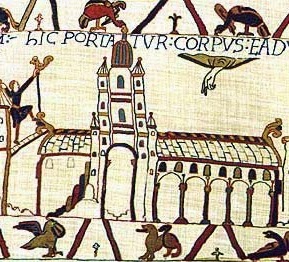
Image from teh Bayeux Tapestry of the old Westminster Abbey, built by Edward the Confessor
On 28 January 1237, Henry III confirmed Magna Carta in a great assembly at Westminster. This was the first confirmation of the 1225 issue of Magna Carta – the version that was to endure throughout the thirteenth century and parts of which remain on the statue books today.
 
By the end of 1236, Henry was in desperate need of cash. His marriage to Eleanor of Provence in January 1236 had been expensive and he had promised £20,000 to Emperor Frederick II as the marriage portion of his sister, Isabel. In line with clause 12 and clause 14 of Magna Carta 1215, the only way to secure a tax was by the consent of his prelates and magnates. Accordingly, Henry fixed a date of January 1237 for an assembly (or, rather, a ‘parliament’, for this was the first meeting described as such in official records).
 
According to the St Albans chronicler Matthew Paris, ‘an infinite multitude of nobles’ attended the parliament, which took place at the palace of Westminster. When they were all seated, William Ralegh (the king’s most senior judge) rose and, ‘as if a mediator between the king and the magnates of the kingdom’, set out Henry’s request. As with other taxes of this period, the king didn't have a specific sum in mind but a proportion (that is, a proportion of the value of people’s moveable goods). The sum requested was a thirtieth.
 
The king’s demand was met with an angry response from bishops and barons. They complained ‘indignantly’ about the various taxes they had been made to pay in recent years, as well as Henry’s neglect of their interests. Disturbed by this outburst, Henry promised that in future he would abide by the counsel of his native magnates. He fervently denied rumours of any attempt to procure an annulment of Magna Carta from the pope and promised, there and then, to observe the Charter.
 
Henry did acknowledge, though, that his behaviour over the previous few years had not been spotless. In fact, his tendency to listen to bad counsel might well have caused him to fall under the general sentence of excommunication that had been pronounced in 1225 by the then archbishop of Canterbury, Stephen Langton, against all who violated Magna Carta. Accordingly, Henry arranged for the sentence to be renewed by the current archbishop, Edmund of Abingdon. This was done in a solemn ritual held in St. Katherine’s chapel in Westminster abbey (this was the old building, founded by Edward the Confessor - Henry didn’t start work on his new abbey until 1245). The king stood with his right hand on the Gospels and his left hand clutching a lighted candle and swore to observe Magna Carta from that day onwards. The archbishop and prelates proclaimed ‘Let it be done’ and threw down their own candles to extinguish them. This caused a great amount of smoke and an unpleasant smell that irritated the eyes and nostrils of the audience. The archbishop, though, recognised this as a teachable moment and declared: ‘Thus let the condemned souls of those who violate the Charter, or who interpret it improperly, be extinguished, and let them likewise smoke and stink.’
 
Henry was to confirm the 1225 issue of Magna Carta again in 1253 and 1265, both times enforced by a sentence of excommunication.