Visit The Magna Carta Project website for more on Magna Carta and King John.
Showing posts with label Henry III. Show all posts

Sunday, 12 October 2014

Henry III and Edward the Confessor

Edward the Confessor, 
 BL Royal 20 A II f.5
13 October is the feast of the translation of Edward the Confessor, spiritual patron of Henry III. In 1245, Henry began to rebuild Westminster Abbey in the Confessor’s honour and, from around the same time, made every effort to be present at Westminster on both of his patron’s feastdays (the other being the anniversary of the Confessor’s death, 5 January).  

How and why did Henry become attached to the Confessor? In an article for English Historical Review of 2007 David Carpenter argued that, in the mid-1230s, Henry began to look to the Confessor for a model of consensual kingship. This followed the fall of Peter des Roches, bishop of Winchester, who had exercised a malign influence upon the king between 1232 and 1234. ‘Imperious and impervious... he had boasted of “the plenitude of royal power”, ridiculed the principle of “judgement by peers” and hurried Henry into a series of disseisins per voluntatem regis . During his regime, the very future of Magna Carta had seemed at stake. It was on this form of rule that Henry turned his back.’
‘The spiritual life of King Henry III revolved around his veneration for Edward the Confessor. The abiding testimony to that, of course, is Westminster Abbey which Henry rebuilt in Edward’s honour, and where he still lies entombed beside the battered remnants of the jewelled and tessellated shrine to which he translated Edward’s body. The pre-eminence of the cult in Henry’s mind can be gauged from the number of paupers he fed each day, as revealed by the household roll for the regnal year 1259 – 60. On 5 January 1260, the anniversary of Edward’s death in 1066, the number was 1,500; on 12 and 13 October 1260, the vigil and anniversary of the saint’s translation in 1163 (always the more important feast), it was 5,016. The next largest total during the year was the 464 fed on the vigil and feast of Pentecost.
Many scholars have written about Henry’s devotion to the Confessor, none more brilliantly than Paul Binski in his book, Westminster Abbey and the Plantagenets: Kingship and the Representation of Power 1200 – 1400. But there exists no detailed consideration of exactly when and why Henry became attached to the saint. Binski himself assigns the process to the 1220s and 1230s, without being more precise. He observes that "why Edward suddenly came to prominence early in the reign of Henry III is unknown". This paper will argue that Henry’s devotion to the Confessor was established in a very few years in the 1230s, to be exact between 1233 and 1238. It was the result of the peculiar circumstances of those years, circumstances which made Westminster Abbey redouble its efforts to attach Henry to the saint, and rendered Henry desperate for the support of a spiritual patron. A particular Westminster monk, Richard le Gras, the disastrous regime of Peter des Roches, Bishop of Winchester, and Henry’s marriage to Eleanor of Provence are also part of the story.’

Tuesday, 13 May 2014

Magna Carta and Excommunication in 1253

Excommunication ceremony (BL, Royal 6 E VI f.216v)
On 13 May 1253, the Archbishop of Canterbury and thirteen of his suffragan bishops pronounced a sentence of excommunication in the great hall at Westminster, against anyone who violated ecclesiastical liberties or the liberties contained in Magna Carta and the Charter of the Forest. Although sentences of excommunication had been pronounced against violators of the charters previously, notably in 1225 and 1237, this is the first for which a text survives. The bishops invoked the Trinity, the Virgin Mary, Saints Peter and Paul, and all saints and martyrs, as well as the champion of the English Church St Thomas Becket, and the canonised Anglo-Saxon king, Edward the Confessor. They then proceeded to ‘excommunicate, anathematize, and sequester from the threshold of the holy mother Church’ all those who deprived churches of their rights, or who violated, infringed, or diminished the free customs and liberties of the realm, especially those contained in the Charters. Anyone who disturbed the peace of the kingdom was also excommunicated.

The ceremony performed by the bishops was described by the monastic chronicler Matthew Paris, who wrote that as the sentence was finished and the candles held were thrown down (so that they were extinguished and smoking), everyone said, ‘Thus are extinguished and stink in hell those who attack this sentence’, and bells were rung. The king himself declared, ‘so help me God, I will faithfully guard all these terms inviolate, as I am a man, as I am a Christian, as I am a knight, and as I am crowned and anointed king’. Paris noted that before the sentence had begun the king had been offered a candle to hold himself, but had declined on the grounds that this was improper because he was not a priest. Instead he held his hand to his chest for the entirety of the sentence, with a cheerful expression on his face.

The background to this solemn pronouncement was that the bishops had called for the king to renew and confirm the Charters, and in return they would agree to grant him a large tax. David Carpenter has discussed the negotiations surrounding this confirmation in detail, but key to understanding these events is that it was the bishops, rather than the secular nobles, who pushed for the confirmation. This was largely because the clerical tax requested was considerably more substantial than the tax imposed on the laity. It is therefore significant that the sentence of excommunication protected the Charters, but not only the Charters. It in fact begins by protecting the liberties of churches, and in a separate clause the liberties contained in the Charters. The bishops thus tightly bound the freedom of the Church to the freedoms in Magna Carta.

The sentence was later pronounced in the localities, in every parish church of the country. In the dioceses of Lincoln and London, however, it was also pronounced in secular spaces, with priests turning up at county courts with hand-bells to fulminate the anathema. Paris noted the particular efforts to have the sentence publicised by Robert Grosseteste, the bishop of Lincoln, who died later in 1253. Paris claimed that he did this because he was afraid that the king would renege on his promises. The text was also confirmed the following year by Pope Innocent IV, and at the end of the decade by Alexander IV. Innocent appointed the dean of Lincoln, Richard Gravesend, to publish the sentence of excommunication. Gravesend ordered each bishop to ensure that it was pronounced not only in every church of the country, but also in all public assemblies. This was to be done in both English and French.

From 1253, every time infringers of the charters were excommunicated, it was this 1253 text that was used. Confirmations of the Charters were frequently sought by both bishops and the secular nobility for the remainder of Henry III’s reign, and again during the reign of Edward I. Particularly important confirmations of the Charters, with renewals of the excommunication, occurred during the conflicts between the king and the barons in the middle of the century, during the period of reform and rebellion, and at the end of the century when the Charters were reissued as the Confirmatio Cartarum. Public Magna Carta excommunications pronounced later in the century and in the fourteenth century were again followed by orders that the sentence of excommunication and the Charters themselves should be published in local parishes in the vernacular. This important tradition of publishing Magna Carta in the vernacular in local churches, with a solemn ceremony of excommunication, started in 1253.

This blog is contributed by Felicity Hill (UEA), whose doctoral research looks at excommunication and politics. 

Thursday, 27 March 2014

Review: 'The Greatest Knight: William Marshal' (BBC 2), presented by Dr Thomas Asbridge


Dr Thomas Asbridge
Following hot on the heels of the first instalment of Robert Bartlett’s BBC series on the Plantagenets comes another BBC production, ‘The Greatest Knight: William Marshal’, a documentary presented by Thomas Asbridge. Marshall, Asbridge tells us at the outset, is a ‘forgotten hero of our history’. While this assertion is sure to have induced puzzlement among students of the Middle Ages, it may be interpreted as a sign that Asbridge’s efforts are targeted at a general audience.
 
Much of what was covered in last night’s documentary is well-trodden ground, in some cases quite literally so, given that several of the locations visited by Asbridge, including the tomb of Henry II at Fontevraud, the hall of the ducal palace in Poitiers, and the castle of Le Mans, all featured in the first episode of Bartlett’s Plantagenets series. The chronological scope of Asbridge’s documentary – from the middle of the twelfth century during the reign of King Stephen down to the Magna Carta crisis – is also the same as Bartlett’s first episode. More striking, however, is the proximity between Asbridge’s documentary and Saul David’s 2008 Timewatch special on William Marshal. The 2014 and 2008 productions share a title (‘The Greatest Knight’). Like David, Asbridge took a New York cab to the Morgan Library in order to consult the manuscript containing the History of William Marshall. Asbridge spoke to the same curator (one William Voelkle) featured in the Timewatch episode, and even highlighted a passage in the History to which David had drawn attention (that wherein the young Marshall is described as lazy and greedy). In terms of presenting style, Asbridge is more of a Bartlett than a David. Whereas David’s documentary featured ‘talking head’ interjections from prominent scholars including David Crouch and David Carpenter, Asbridge, like Bartlett, generally eschews that approach. The difference between the presenting styles of Asbridge and David are manifest in other ways. David sought to try and see the world through Marshal’s eyes by donning armour and taking part in a joust. Asbridge in contrast, limited himself to a careful twirl of one of the Wallace Collection’s oldest swords. To do so, he had to don blue surgical gloves, and contend with a curator hawkishly watching over him.

Given the familiarity of the subject matter of this documentary, then, did Asbridge succeed in putting his own stamp on proceedings? In one important respect, he did. He accomplished this by placing the History of William Marshall (‘a priceless window into the Medieval world’) at the very heart of his enquiry. When introducing the History near the outset, Asbridge pointed out that historians must interpret this text as a literary construction written to project a carefully tailored image of its subject. He acknowledges that the historical Marshall and the characterisation of him in the History are not necessarily one and the same. (The extent to which the latter can be disaggregated from the former is a matter that often vexes modern scholars). In conversation with the Morgan Library’s curator, Asbridge even adduces some of the salient details regarding the circumstances of the History’s provenance and reception. This is an approach which exhibits a high level of trust in the audience’s critical ability. It is not typical of a primetime documentary intended for airing on the BBC, and is all the more admirable for it.
 
The hour unfolded with Asbridge tracing the course of Marshal’s life, pointing out certain moments wherein he appears to have acted out of a desire to conform to the contemporary martial ethos which governed knightly behaviour – or, as Asbridge called it, chivalry. While academics might take issue over what ‘chivalry’ consisted of in the age of William Marhsall, and the extent to which it actually did have a bearing on the thoughtworld of the warriors of that period, it would have overcomplicated matters to have done so in this context. Asbridge’s interest focussed chiefly on Marshal’s role in the high politics of his age. The choice to open and close the documentary at Westminster was deliberate; for Asbridge, the ‘greatest revelation of William Marshal’s life’ were the attempts by men of his ilk to limit royal power, which played a part, his argument went, in the development of the system of governance under which we in Britain presently live. There is perhaps no audience better qualified than those who read this blog to discuss how that claim squares with Marshal’s vigorous attempts to shore up royal authority over the rebellious barons of England during the first years of Henry III’s minority after John’s death in 1216.


Friday, 21 February 2014

In the finest tradition: the right of English bishops to reprimand the king

Two bishop saints, mid-13thC, BL, Royal 2 B VI, f.11
Recently, the archbishop of Westminster Vincent Nichols spoke out in the national press against the government’s cuts to welfare spending, labeling the policy ‘a disgrace’ that threatened to abandon society’s most vulnerable to ‘hunger and destitution’. Yesterday, a coalition of 27 Anglican bishops and 16 other faith leaders wrote a letter to the Mirror in support of Nichols’ message. The bishops’ intervention raises an important question about the role of religious leaders in politics, in a modern western world that many would categorise as secular. The prelates should take comfort, though, that they have history on their side.

English bishops since before the Norman Conquest had a duty – a responsibility, in fact – to reprimand kings when they acted immorally. For instance, the tenth-century archbishop of Canterbury, St Dunstan, after catching King Eadwig in flagrante delicto (‘sprawled between his whores, his crown flung off, some way away on the floor’), threatened the king with excommunication, ‘took him by the hand, replaced the crown, and dragged him forcibly from the room.’ Thankfully, no such demand has yet been placed on today’s bishops.

Dunstan’s right to wag his finger at the king was based partly on Biblical precedent. Old Testament prophets, seen as the forerunners of the Christian clergy, had reprimanded King Saul and King David when they sinned. The medieval bishops’ authority was also based on their role in the coronation. Since 973, English bishops had received the coronation oath – a promise to rule justly – from the king. They also anointed him with holy oil. Since bishops made the king, they also were duty-bound to call him to account.

Their remit for overseeing royal action expanded as time went on. Famously, Thomas Becket criticised Henry II for his treatment of the Church and the quarrel escalated to the point of lethal violence. But, in the thirteenth century, the bishops also kept their eye on royal policy more generally, for the good of the wider kingdom. Crucial to this development was Stephen Langton, archbishop of Canterbury 1207-26. Langton was a prodigious scholar of the Bible and took the clergy’s responsibility for chastising wayward kings very seriously.  As archbishop of Canterbury, he put this thought into action by taking it upon himself and his colleagues to enforce Magna Carta. Magna Carta bound the king to act within the law and regulated the king’s treatment of his subjects across society. Whether or not Langton helped to compose the Charter – and there is real doubt that he did – he came to be one of the Charter’s most vigorous supporters.

It was Langton who, in 1225, stepped in with his fellow bishops to pronounce a sentence of excommunication against anyone who dared break the Charter’s terms. This was an important move because, since 1216, the Charter had contained no means of enforcement. The original issue of Magna Carta in 1215 included the security clause, which empowered 25 barons to seize the king’s possessions if he failed to abide by the Charter. When a new version was issued on behalf of the young king Henry III in 1216, this controversial clause was left out. This meant that there was no clear way to call the king to account if he failed to keep Magna Carta. Langton’s decision to use spiritual punishment now gave the Charter teeth. The threat of excommunication was one that the king would have taken very seriously, because the sentence would mark him as an outsider in the Christian community and might also give his subjects licence to rebel.

Langton’s actions in 1225 were a model for his successors. In 1234, a new archbishop of Canterbury, Edmund of Abingdon, publicly chastised Henry III in an assembly at Westminster for the king’s willingness to listen to evil counsel, berating him for the damage that his policies were doing to the kingdom and his subjects. Edmund threatened the king with excommunication if he did not mend his ways. Henry listened to the archbishop’s advice and threw out the bad counsellors. In 1237, Edmund enforced Henry’s confirmation of Magna Carta by sentence of excommunication. His later successor, Boniface of Savoy, did the same in 1253 and again, in 1265, the English bishops reiterated the sentence. Although today we might not live in a world where government leaders fear the reprimands of Church leaders, Langton would be pleased to hear (as reported in the Mirror) that at least Mr Cameron was ‘rattled’ by the bishops’ reprimand. Vincent Nichols, Justin Welby and their colleagues should feel assured that they are acting in the finest tradition of the English clergy.  

Read more on bishops, kings and Magna Carta:
S. T. Ambler, ‘The Montfortian Bishops and the Justification of Conciliar Government in 1264’, Historical Research, 85 (2012), 193-209


D. A. Carpenter, ‘Archbishop Langton and Magna Carta: His Contribution, His Doubts and His Hypocrisy’, EHR, 126 (2011), 1041-65

D. L. d'Avray, ‘«Magna Carta»: its Background in Stephen Langton’s Academic Biblical Exegesis and its Episcopal Reception’, Studi Medievali,ser.3, 38:1 (1998), 423-38

B.K. Weiler, ‘Bishopsand Kings in England, c.1066-1215’, in L. Körntgen and D. Waβenhoven (eds.), Religion and Politics in the Middle Ages:Germany and England by Comparison (De Gruyter, 2013), 157-203

Friday, 14 February 2014

On the Feast of St Valentine, 1265: Simon de Montfort's parliament and Henry III's promise to keep Magna Carta

DAC does Henry III 
Today might be the feast of St Valentine but, on this day in 1265, Henry III’s heart must have turned cold. Held prisoner by Simon de Montfort, he stood humiliated in the chapter house of his beloved Westminster abbey while an announcement was made that he had sworn to subjugate himself to Montfort’s council. At the same time it was proclaimed that Henry had vowed to abide by Magna Carta. Whilst a royal promise to keep the Charter was nothing new (the 1225 issue of Magna Carta had been confirmed by Henry in 1237 and 1253), circumstances in 1265 made this occasion very different. Henry’s oath was not part of a mutual bargain between king and subjects, provided freely in return for a grant of taxation. Instead, it was extracted from him by force. Defeated on the field of battle at Lewes in May 1264, and held captive by the triumphant Montfort, now de facto ruler of England, the king had no choice but to endorse Magna Carta and the radical Montfortian constitution in the same breath.

Henry’s situation was all the more demeaning because the scene of his humiliation, Westminster abbey chapter house, was the very place Henry had built to profess the majesty of his rule. He had begun the rebuilding of Westminster abbey in 1245 (in honour of his patron saint, Edward the Confessor) and had personally overseen the design of the chapter house. Envisaging a venue where he would meet his nobles in parliament, the king had commissioned a lectern decorated with wrought iron and, possibly, gilding. Henry must have imagined himself making dignified speeches, stood on the magnificent tiled floor that bore his coat of arms, bathed in light from the house’s vast windows, surrounded by prelates and magnates who sat awed by his authority. Instead, the king stood dumb (if, in fact, he was there at all) while a rebellious subject announced on his behalf that the king was now subject to conciliar rule.

The history of Magna Carta is bound up with that of Westminster abbey. The old abbey had been a site for assemblies since the days of its founder, Edward the Confessor, and it was there in St. Katherine’s chapel that Magna Carta had been confirmed in 1237. The chapter house of the new abbey was built by the first king to govern under the Charter’s restrictions and was designed with the new modus vivendi for ruler and ruled in mind. Even if the events of 14 February 1265 showed that this relationship had been usurped by a more radical model, it was here in the chapter house that the importance of Magna Carta in the language of good government was confirmed.

Henry’s confirmation of Magna Carta in 1265 is discussed in a Feature of the Month on the Magna Carta Project website. For more on Henry’s chapter house, see: D. A. Carpenter, ‘King Henry III and the Chapter House of Westminster Abbey’, in R. Mortimer (ed.), Westminster Abbey Chapter House: The History, Art and Architecture of 'a Chapter House Beyond Compare' (London: Society of Antiquaries of London, 2010), 32-9

Tuesday, 28 January 2014

Henry III's Confirmation of Magna Carta in 1237


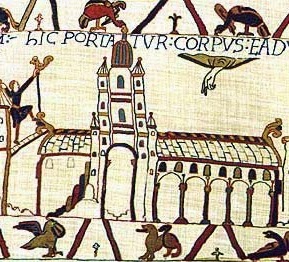
Image from teh Bayeux Tapestry of the old Westminster Abbey, built by Edward the Confessor
On 28 January 1237, Henry III confirmed Magna Carta in a great assembly at Westminster. This was the first confirmation of the 1225 issue of Magna Carta – the version that was to endure throughout the thirteenth century and parts of which remain on the statue books today.
 
By the end of 1236, Henry was in desperate need of cash. His marriage to Eleanor of Provence in January 1236 had been expensive and he had promised £20,000 to Emperor Frederick II as the marriage portion of his sister, Isabel. In line with clause 12 and clause 14 of Magna Carta 1215, the only way to secure a tax was by the consent of his prelates and magnates. Accordingly, Henry fixed a date of January 1237 for an assembly (or, rather, a ‘parliament’, for this was the first meeting described as such in official records).
 
According to the St Albans chronicler Matthew Paris, ‘an infinite multitude of nobles’ attended the parliament, which took place at the palace of Westminster. When they were all seated, William Ralegh (the king’s most senior judge) rose and, ‘as if a mediator between the king and the magnates of the kingdom’, set out Henry’s request. As with other taxes of this period, the king didn't have a specific sum in mind but a proportion (that is, a proportion of the value of people’s moveable goods). The sum requested was a thirtieth.
 
The king’s demand was met with an angry response from bishops and barons. They complained ‘indignantly’ about the various taxes they had been made to pay in recent years, as well as Henry’s neglect of their interests. Disturbed by this outburst, Henry promised that in future he would abide by the counsel of his native magnates. He fervently denied rumours of any attempt to procure an annulment of Magna Carta from the pope and promised, there and then, to observe the Charter.
 
Henry did acknowledge, though, that his behaviour over the previous few years had not been spotless. In fact, his tendency to listen to bad counsel might well have caused him to fall under the general sentence of excommunication that had been pronounced in 1225 by the then archbishop of Canterbury, Stephen Langton, against all who violated Magna Carta. Accordingly, Henry arranged for the sentence to be renewed by the current archbishop, Edmund of Abingdon. This was done in a solemn ritual held in St. Katherine’s chapel in Westminster abbey (this was the old building, founded by Edward the Confessor - Henry didn’t start work on his new abbey until 1245). The king stood with his right hand on the Gospels and his left hand clutching a lighted candle and swore to observe Magna Carta from that day onwards. The archbishop and prelates proclaimed ‘Let it be done’ and threw down their own candles to extinguish them. This caused a great amount of smoke and an unpleasant smell that irritated the eyes and nostrils of the audience. The archbishop, though, recognised this as a teachable moment and declared: ‘Thus let the condemned souls of those who violate the Charter, or who interpret it improperly, be extinguished, and let them likewise smoke and stink.’
 
Henry was to confirm the 1225 issue of Magna Carta again in 1253 and 1265, both times enforced by a sentence of excommunication.

Monday, 6 January 2014

Behind the Scenes on the Magna Carta Project: Henry Summerson on producing clause-by-clause commentary on Magna Carta 1215


As well as making available a new English translation of Magna Carta 1215, The Magna Carta Project is producing expert commentaries on every clause of the Charter, with versions available for schools, the general public and scholars.  For this blog, Dr Henry Summerson, Research Associate on the Magna Carta Project, describes his role in writing the commentaries. 
  
I see my role in the Magna Carta Project as that of an all-rounder who has been recruited to support a team of specialists.  The authors of the commentary on a number of chapters pretty well choose themselves – Paul Brand for the ones dealing with legal matters, Louise Wilkinson for those relating to matters like inheritance and marriage, David Carpenter for chapters which link politics and government, and so on.  But that still leaves about half of the chapters which make up the Charter unassigned, some of them concerned with issues which have never received much scholarly attention – Number33, for instance, about fish-traps in the Thames – while others are celebrated ones which have been repeatedly debated from the seventeenth century onwards, like Number 40, in which King John promised that he would not sell, defer or deny justice.  Obscure and famous alike, they make up my responsibility, to be researched and interpreted, for what seems like the first time in some cases, for the umpteenth times in others.
 
If I’m to have any chance of saying something new about the well-known chapters, or of shedding light on the obscure ones, I’ve got to research them all as fully as possible.  Fortunately practically all the available sources (of which there are surprising, and sometimes alarming, amounts) are in print.  Less fortunately, what are probably the most important ones, the volumes published by the Record Commission in the 1830s and 1840s, which record the day-by-day workings of King John’s government, came out before the invention of the subject index.  They’ve got impressively detailed indexes of people and places, but that is all.  This means that unlike present-day publications of, say, the Selden Society or the Pipe Roll Society, they offer no lists of headings to guide me round their contents, and the only way I can discover what is in them is to read them, all of them, again and again.  To do that for every chapter in turn would be an impossibly time-consuming undertaking, and so I tackle them in batches, dealing with four or five chapters at a time.  This is still a slow business, but it has the advantage of enabling me to keep an eye out for things which I missed in earlier trawls – one of the great advantages of electronic publishing is that it’s easy to correct or amplify texts which have been put up on-line.
 
So for each batch I start by reading right through the Record Commission editions of the Close Rolls, Patent Rolls, Fine Rolls etc., noting down relevant material as I go, and then – with some relief – I turn to the Pipe Rolls.  These do have subject indexes, admittedly rather rudimentary ones for the years before 1189, but very full ones for later years, and I start by going through these, though I always end up skimming the complete text as well, since even the best subject index can’t be expected to cover every possible issue.  I treat the Curia Regis Rolls, which have impressively detailed indexes, in much the same way, and also relevant Selden Society volumes.  For ecclesiastical affairs I turn principally to the English Episcopal Acta series.  Then there are administrative records like the Book of Fees, and texts like Glanvill and the Dialogue of the Exchequer, the latter reinforced by Thomas Madox’s Antiquities of the Exxhequer – some 250 years old now, in its second edition, but based on a reading of twelfth- and thirteenth-century records so extensive as to make it practically an original source in its own right.  
 
After that I turn to the narrative sources, the contemporary accounts of the reigns of the Angevin kings by men like Roger of Howden, Gervase of Canterbury and Roger of Wendover.  Of varying reliability, and often wildly prejudiced, the likely biases of these chronicles have always got to be kept in mind, though they also help to give them vitality, and may in any case reflect opinions held by others besides those of the men who wrote them.  Many of these texts are available in the Rolls Series, or have been published by Nelson/Oxford Medieval Texts, but some important chronicles – the History of William Marshal, for instance, or the Histoire des ducs de Normandie – have to be consulted in free-standing editions.  All these works can present problems of interpretation; for help in understanding individual words, and what they signified in the years round 1200 (some commonly-used words could have five or six different meanings), I make continual use of the recently completed Medieval Latin Dictionary. I always leave reading secondary material until last, since I like to form my own impressions of the issues represented by a chapter in Magna Carta before finding out what other historians have made of them.  Every generation has its own point of view – or sometimes several points of view - about the Charter, and some great historians have given expression to it, from Stubbs and Maitland in the late nineteenth century via McKechnie, Jolliffe, Stenton (both of them) and Mitchell, down to Sidney Painter and Sir James Holt in recent times, and indeed beyond, to scholars working today.   I don’t think of myself as engaged in a debate, still less a quarrel, with what eminent scholars of past generations have written about Magna Carta, but I do need to know what their views were, and (if possible) why they held them.  And at a less exalted level, I also need to keep an eye out for what can be very valuable material published in specialist journals (when working on the fish traps, for instance), or by county record societies.  The Royal Historical Society’s on-line bibliography is a great help in tracking down sometimes recondite books and articles.  I’ve got to be selective in the books and articles I consult if I’m ever to write anything myself, but here, as in other respects, I’m helped by the organisation of the Magna Carta project, since everything I write is read by my colleagues, who can draw my attention to anything important I’ve missed.
 
I’m also helped, in a different way, by my additional responsibility for providing commentaries for general readers and for secondary school pupils.  My principal task involves writing commentaries for an academic readership of scholars like myself and my colleagues, but the project has a wider remit, to put its learning at the disposal of people who want to know about Magna Carta, but not necessarily all about it.  I compose these supplementary commentaries last, basing them on, and constantly referring back to, the longer texts I’ve just composed, and the need to express myself concisely and clearly, without using technical language, makes them a valuable control on these – I’ve often picked up mistakes and inconsistencies, and realised that I’ve been vague just where I need to be precise, while doing this.  And when all that’s done, the commentaries can finally go up on the project website.  I’ve had no feedback yet, but look forward to getting some, even if it does make corrections necessary – it will all help in the task of interpreting Magna Carta, a process that has never ceased and is not likely to.
 

Monday, 9 December 2013

Christmas at the Court of King John


With the season of Advent underway, many of us will be frantically planning our Christmas celebrations. There’s the food for Christmas lunch (have I bought enough? Do I have enough plates for everyone?), the booze (how sozzled do we plan to get?) and of course, the tricky issue of presents (what on earth do I buy the mother-in-law?). In the thirteenth century, King John and Henry III faced similar problems.

King John had to plan Christmas Day at least a week in advance because of the large quantities of food required for his feast. Once the king had decided where he would spend Christmas Day, a command would be sent to the local sheriff ordering him to rustle-up the necessary supplies. There would be hundreds of mouths to feed, so this was no easy task – in fact King John’s shopping list puts our Christmas-shopping nightmares in the shade. In 1206, an order was dispatched to the sheriff of Hampshire on 13 December to find 1,500 hens, 5,000 eggs, 20 cattle, 100 pigs and 100 sheep for the king’s Christmas festivities at the royal palace of Winchester. Thankfully for the sheriff of Hampshire, the task of ordering the table settings was delegated to his colleague in Wiltshire, who had to procure 500 ells of linen for making tablecloths.

In 1213, the task of organising King John’s Christmas feast at Windsor castle was even more daunting. Reginald de Cornhill, in charge of purchasing luxury goods for the royal household, was presented with an epic shopping list and barely a week to fulfil the order. No Christmas feast would be complete without plenty of booze, so the king would need wine: 20 tuns of good and new ordinary wine, both French and Gascon, and 4 tuns of the best stuff that Reginald could lay his hands on (2 of red, 2 of white) for the king’s table. Then there was the food: 200 pigs’ heads with all the pickled pork, 1,000 hens, 50 pounds of pepper, 2 pounds of saffron, 100 pounds of good fresh almonds and 15,000 herrings, as well as spices for making sauces, two dozen towels and 1,000 ells of linen for making tablecloths. But even this huge order would not suffice for the royal feast and so other officials were tasked with finding another 200-odd pigs’ heads, 15,000 more hens as well as 10,000 salted eels and all the pitchers, cups and dishes that would be needed to serve the diners.

How much did this all cost? It’s hard to say, because no household rolls survive for King John’s reign (we have two misae rolls, listing the king’s diverse expenses, but they hardly include anything in terms of Yuletide procurement). But some household rolls do survive from the reign of John’s son, Henry III, and these reflect a dramatic increase in spending at Christmas time. While the normal daily spend for the royal household in 1225 was £6 or £7, the cost of food, drink and other provisions (wax, firewood etc.) for Christmas Eve and Day at Winchester that year was over £51.

And this is all before one takes into account the king’s spending on gifts for family and servants. King John was famous for his largesse and was generous in providing robes for his men. At Christmas in 1214, he kitted out 7 knights, 6 serjeants, the royal chaplains and 13 other members of the household in robes of green. John was also keen to ensure that all of his men were properly looked after. When one of his crossbowmen, Hugh, fell ill on Christmas Eve 1205 during the Christmas festivities at Oxford, John ordered the local sheriff to find 12 pence per day for Hugh’s convalescence and to provide Hugh with 20 shillings for robes. The presentation of robes was an important demonstration of the king’s largesse and complaints were voiced in 1250 when Henry III, scrimping on gifts in an effort to save up for his planned crusade, failed to distribute any robes or jewels (then as now, even when times were tough people still expected a good show). In 1242, though, Henry had wisely put his best efforts into a suitably splendid gift for his mother in law. Henry had married Eleanor of Provence in 1236 and, when her mother Beatrice visited at Christmas 1242, Henry was clearly eager to impress. He commissioned his tailors to make a robe of the ‘best scarlet cloth that can be found in the city of London’ for Beatrice’s Christmas present. Obviously concerned that this would be deemed insufficient, Henry also gave Beatrice a £400 annual fee for six years and presented her, on New Year’s Day, with a golden figure of an eagle (representing her family’s emblem) inlaid with precious stones, at the cost of some £100.

How did King John spend Christmas Day itself? His father, Henry II, had hosted a famously ribald court, whose annual Christmas entertainment included a display of leaping, whistling and farting by one Roland the Farter. But it is hard to imagine that there was much time for fun and games at John’s Christmas court. There was some sort of joshing display put on by the archbishop of Canterbury, Hubert Walter, in which he pretended to outdo the king in largesse when he handed out robes to his men. But otherwise it was business as usual – on Christmas Eve and Christmas Day the king continued to receive payment of debts, which must have taken the edge off Christmas cheer. In any case, King John hardly spent enough time in one place to spin out the Christmas fun. His itinerary (a new version of which is underway as part of the Magna Carta Project) shows that he hardly spent more than a day or two at his chosen Christmas residence before he was off again on his endless toing and froing around the kingdom.

How were John’s Yuletide celebrations received? Given the financial pressures John placed on his kingdom, especially after the loss of Normandy in 1204, one might have thought that his extravagant (and no doubt expensive) Christmas festivities might have earned him criticism. Yet displays of royal generosity were a key part of medieval politics and so John’s largesse, unlike other aspects of his rule, was recorded approvingly by chroniclers:
‘he spent lavishly; he gave plenty to eat, and did so generously and willingly. People never found the gate or the doors of John’s hall barred against them, so that all who wanted to eat at his court could do so. At the three great feasts he gave robes aplenty to his knights. This was a good quality of his.’ (Histoire des ducs de Normandie et des rois d’Angleterre, translated by John Gillingham).