Visit The Magna Carta Project website for more on Magna Carta and King John.
Showing posts with label Magna Carta 800. Show all posts

Wednesday, 10 February 2016

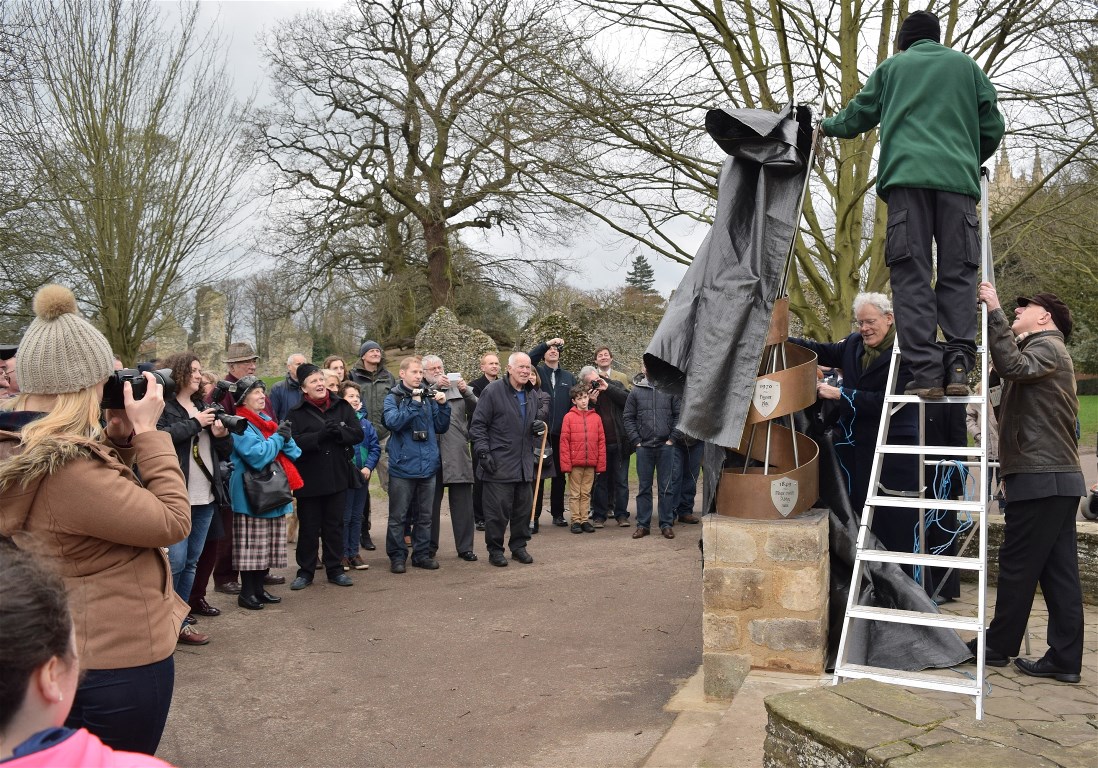
David Carpenter unveils Bury St Edmunds sculpture

The Magna Carta Project's David Carpenter was recently called upon to help unveil a sculpture in Bury St Edmunds.'Our Liberty' commemorates the role of the town in the events surrounding Magna Carta - according to the chronicler Roger of Wendover, a group of discontented barons met at the abbey in the autumn of 1214 and sworn to unite in resistance to King John. You can read a translation of Wendover's account, together with a commentary by the MCP's Nicholas Vincent, on the Magna Carta Project site. For a vindication of Wendover's account, see David Carpenter's book Magna Carta (2015), pp. 290-95. You can read more about the Bury sculpture via the Magna Carta Trust.
David helps to unveil the sculpture in Bury
David with the mayor of Bury, Margaret Charlesworth, and other dignitaries

Friday, 14 August 2015

Festival of Freedoms


This September, members of the Magna Carta Project will be taking part in Parliament’s Festival of Freedoms. The Festival is part of Parliament in the Making, a year-long cultural and education programme that commemorates a series of major anniversaries including 750 years since Simon de Montfort’s parliament and 800 years since the sealing of Magna Carta.


Westminster Hall, site of the
1265 parliament 
On 15 September, Sophie Ambler will be talking at Portcullis House on ‘What Happened at Simon de Montfort’s Parliament?’. De Montfort’s parliament of 1265 is celebrated as a pivotal episode in the history of politics. But why was the parliament summoned and what actually took place? Sophie will describe the tumultuous context of the parliament, with England’s king imprisoned and the kingdom ruled by a council of his subjects, and examine new evidence to reconstruct the events, personnel and atmosphere of the meeting, in order to reveal the dramatic course of the parliament and its theatrical climax. 

Statue of
Llewelyn the Great,
Conwy
On 17 September, David Carpenter will be speaking at The National Assembly for Wales on ‘Wales and Magna Carta in 1215’. Magna Carta, one of the most famous documents in world history, was sealed 800 years ago in 1215. Here, David will explore the crucial role played by the Welsh rulers in the creation of the Great Charter. Focussing on the rebellion against King John by Llewelyn, Prince of North Wales (later known as Llewelyn the Great) and his allies, he will examine the chapters in Magna Carta dealing with their grievances - revealing that Magna Carta is a very much a British document, with important chapters about both Wales and Scotland.

These events are free and all are welcome but booking is required. To find out more about the Festival of Freedoms, to see the full events listings and to book your place, please visit the 2015 anniversary events page on Parliament’s website. 

Wednesday, 13 May 2015

Surrey in the Age of Magna Carta

Professors Nigel Saul (left) and David Carpenter (right)
at the Surrey History Centre
Magna Carta Project Co-Investigator David Carpenter spoke on Saturday 9th May about 'Magna Carta in the Reign of Henry III', at a Magna Carta study day at the Surrey History Centre in Woking. Here he is with Nigel Saul, of RHUL and the Magna Carta Trust, who spoke about 'Magna Carta in English History'.
You can hear both David and Nigel at the Magna Carta Conference, which will take place at King's College London and the British Library 17-19 June 2015. For more information and to book tickets visit the Magna Carta Project website. 

Sunday, 3 May 2015

Pageants and the People: Bury St Edmunds and Magna Carta

Throughout 2014-15, local communities across the UK are marking the 800th anniversary of Magna Carta with a host of varied festivities – from Odiham's specially commissioned Magna Carta Anthem to Runnymede's parade of picnicking giants. But did you know that Britain has a rich history of commemorating history through such theatrical events? For instance, In 1907, 1959 and 1970 the people of Bury St Edmunds commemorated the Charter by re-enacting events from their town’s past, in three big historical pageants.
The Bury pageant of 1959
Bury’s pageants are being investigated as part of a major AHRC project, The Redress of the Past: Historical Pageants in Britain. The project looks at the part of pageants in community life and how communities expressed their identity through theatrical re-creations of their past. Members of the project team (from King’s College London, the Universities of Strathclyde and Glasgow and the Institute of Education) have been looking at twentieth-century pageants from across the UK. You can see some of the weird and wonderful photographs of these events and read commentary by the team in the Pageant of the Month feature – and you can even upload your own pageant photographs and memorabilia.

The Bury pageant of 1907
The project is helping to commemorate the Bury St Edmunds pageants in a special exhibition in Moyse’s Hall, Bury, which will run from 4th May 2015. On display will be rare film footage of the pageants as well as souvenirs produced for the events – visitors will also be able to have their photo taken with life-size figures of pageant characters. Meanwhile, the Redress of the Past website will host an online version of the exhibition, including behind-the-scenes stories and features. Do take a look! 

Friday, 2 January 2015

David Carpenter's 'Magna Carta' is published with Penguin Classics

1 January 2015 saw the publication of David Carpenter’s new book, Magna Carta, with Penguin Classics. The book provides a new translation of the Charter, presented with original chapter divisions that throw new light on how Magna Carta was understood by contemporaries. 

Reading the text closely, David shows for the first time how the Charter reflected divisions in early-thirteenth society. He also explains the ideas behind the agreement as well as giving a new narrative for the events leading up to Runnymede.

In preparing his book, David has been tracking down copies of Magna Carta 1215, as well as later issues, in medieval records – research that has revealed the existence of numerous drafts of the Charter that were carried off from Runnymede. David’s catalogue of Magna Carta copies can be viewed on the Magna Carta Project Website.

The release of David’s book was featured in a BBC News article by Nick Higham: Just how important is Magna Carta 800 years on?

David has also written an article for the Guardian, which highlights some of his findings.

Together with fellow Magna Carta Project members Nicholas Vincent and Claire Breay, David will be taking part in a four part series on Magna Carta to be aired BBC Radio 4 in January 2015.

Click here to view David’s Magna Carta on Amazon. 

Friday, 17 October 2014

Magna Carta Essay Competition


Professor Sir James Holt (1922-2014)
The Magna Carta Project has established an essay prize in memory of the late Professor Sir James Holt, the great expert on Magna Carta, who died earlier this year. Professor Holt's work on the Charter, including two magisterial books (The Northerners and Magna Carta) has formed an important part of undergraduate syllabuses for decades and continues to inspire students. 

The J.C. Holt Essay Prize will be awarded for the best essay by an undergraduate student answering one of the competition's designated questions on Magna Carta. The prize will be £250, to be presented at the Magna Carta Project conference at King's College London/British Library between 17 and 19 June 2015. The deadline for submissions is 1 March 2015.

The list of questions and full details of how to enter are available on the Magna Carta Project website.

'The men who were responsible for the Great Charter of 1215 asserted one great principle. In their view the realm was more than a geographic or administrative unit. It was a community. As such, it was capable of possessing rights and liberties. Magna Carta was indeed a statement of these rights and liberties, which could be asserted against any member of the community, even and especially against the King. The durability of Magna Carta is to be explained by the general utility of this central concept.' (J.C. Holt, The Northerners)
Tuesday, 7 October 2014

The Four 1215 Magna Cartas at the British Library

King John hunting, from British Library MS Cotton Claudius D II
1,215 members of the public will be able to view the four surviving original Magna Cartas of 1215, which will be brought together at the British Library on 3 February 2015 to mark the 800th anniversary of the Charter’s endorsement. The British Library holds two engrossments of the 1215 Charter; a third is preserved at Lincoln Cathedral and a fourth at Salisbury Cathedral. This will be the first time that all four originals have been brought together. Members of the public can apply for the chance to attend the event via a ballot, which opened this week.

The British Library will also be holding a major exhibition to commemorate the 800th anniversary (Magna Carta: Law, Liberty, Legacy), which will open on 13 March 2015. Members of the Magna Carta Project are advising on the exhibition and will provide chapters for its catalogue. Further information can be found on the Medieval Manuscripts blog.

In preparation for events next year, conservators at the British Library have been subjecting one of their Magna Cartas to multispectral analysis. The document was badly damaged in the Cotton Library fire of 1731, making much of its contents impossible to read with the naked eye. As a result of the images produced by this analysis the text can now be read once more. Further details of the conservation work can be found on the Collection Care blog. 

Saturday, 21 June 2014

Magna Carta Project at Downing Street

Nicholas Vincent and Claire Breay with Prime Minister David Cameron
Nicholas Vincent and Claire Breay of the Magna Carta Project attended a party at 10 Downing Street hosted by Prime Minister David Cameron, on 16 June 2014. The party brought together people involved in celebrating the 800th anniversary, in 2015, of the Charter's first issue. The Prime Minister was keen to hear how plans for the celebrations next year are developing. To see what's in store for next year, see the Magna Carta Trust website.